

We are going to sow a sustainable living fence in the spring. An old fashioned hedge-row. The hedge will be made from Hedge Apple. Early settlers planted the Hedge Apple (Osage Orange) which is in the same family as the Mulberry, as hardy hedgerows and the trees can grow to 50 feet high if left unpruned. The tree is very thorny and when pruned to be quite dense it is very effective as a livestock fence. Horse High, Bull Strong and Hog Tight my Old friends tell me. Well, we will see what Daisy says about that. There is an old wives tale that the actual horse apples repel mice and insects, and there was a time when the apples were lined up around the outside of the house to keep the home pest free. No-one can tell me if this was actually a useful practice. I think I will leave that work for the cats.
So with direction from the Old Codger who I visit twice a week, (everyone needs an old person remember and he is mine) I have gathered the hedge apples. They are called oranges. This gets very confusing. In fact they have many names – Monkey Balls, or Horse Apples among them. These are very old trees and because of their thorns they are no longer popular. But they have dense hard timber, good for fence posts as the wood does not rot and even further back the Osage Indians used this wood to make their bows. That old.

I have filled two big buckets with the strange alien looking oranges. The buckets will be left outside beside the barn for the whole winter. They need to sit out in the weather. They will be rained on, snowed on, frozen, thawed and frozen again and by the spring thaw they should have started to go nice and mushy.
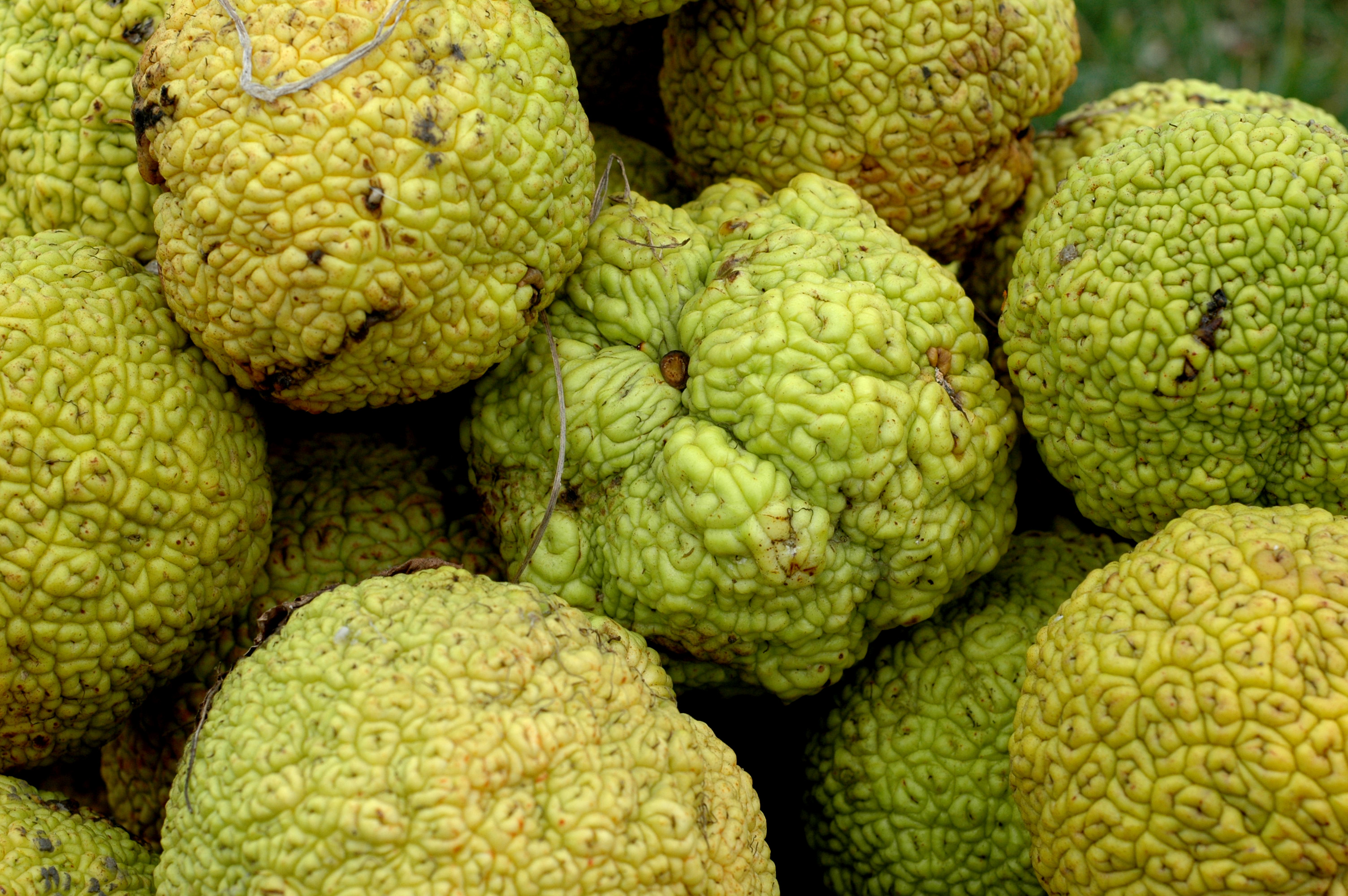
The Old Codger tells me that I should get a potato masher in the spring and ‘smash the mess up’ making a kind of slurry. Then down the back of the potato paddock I shall dig a straight long shallow trench and pour the seeds, pulp and water into the trench in a stream. Then we cover it with soil and see what pops up. I am sure the Old Codger will come down and wave his walking stick about to make sure we do it right. He is 93 and very sprightly. He calls a spade a spade, is an endless source of local information with a razer sharp memory for everything, except when he is meant to take a shower. He loves my fudge. 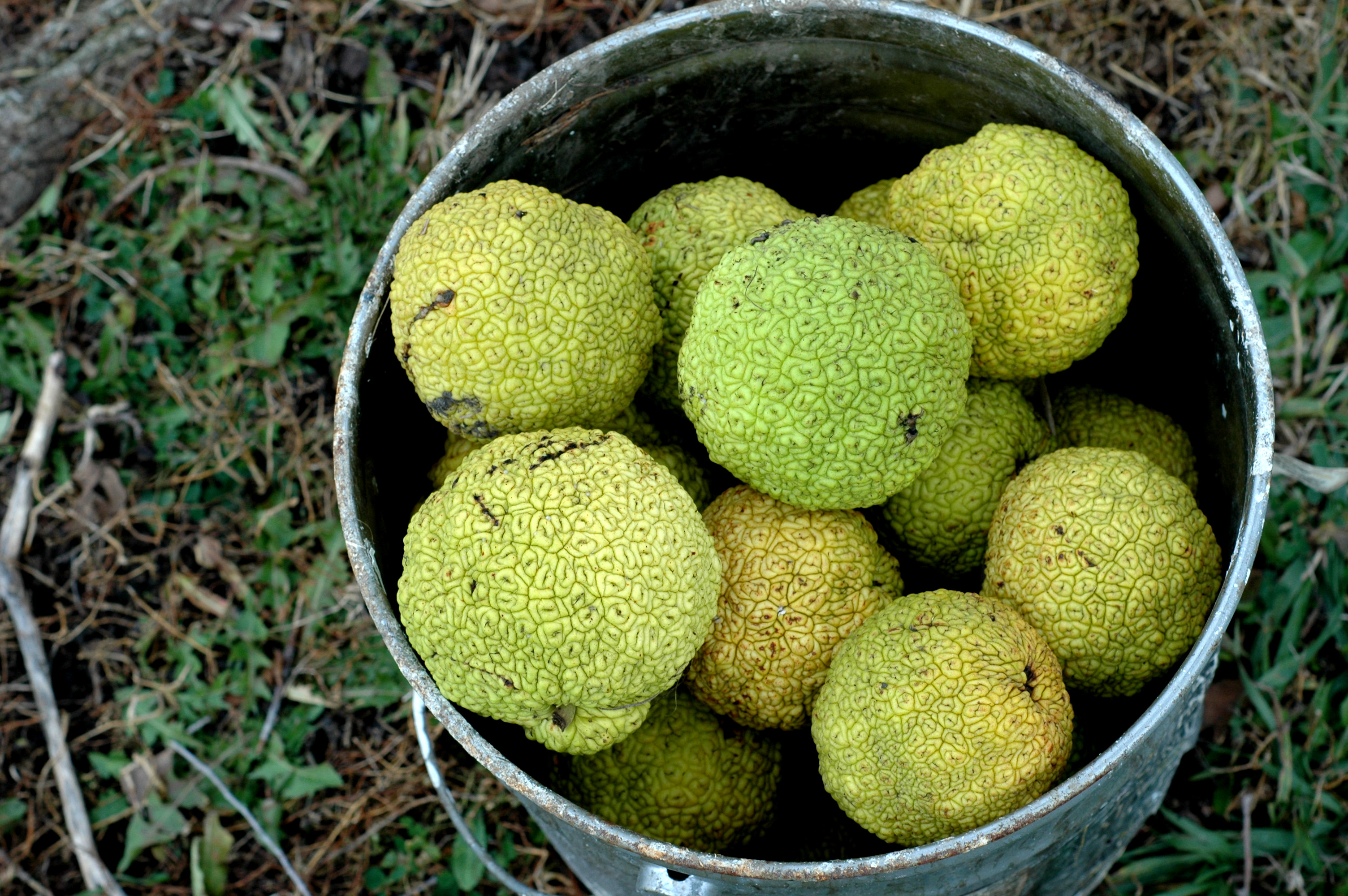
When the wood is young I can train the young canes into arches, creating a fast growing living fence that will control wind erosion, encourage critters (as the Old Codger calls them) and birds, create shelter and shade for the livestock and of course become a living fence. These hedges were used extensively in the midwest during the 1800’s, before barbed wire was used. My old friend told me that when he was young he saw huge steam engines come in and tear them all out. He said they tore down hundreds of miles of fenceline and hedges, making room for big horticultural monoculture. Sending all the native animals and birds looking for cover elsewhere. And setting the soil free to fly away.
He is thrilled to bits that we are going to plant a hedge-apple hedge again. Squirrels love ’em, he said. Don’t tell John that, I said.
c
 The Kitchen's Garden
116 responses to “Recipe for a hedge-apple hedge.”
Where I grew up, they were called Bowdark Apples – an Oklahoma bastarization of Bois D’Arc. 🙂
Don’t leave those pails where you can smell them – they’ll reek long before spring. I think the legend of their pest control abilities comes from their awful odor!
And he’s right about the strength of that wood – I remember 100+ year old barbed wire fences strung on those posts. Good to hear you’re planting them!
I bet they will smell too especially once the thaw hits, when fresh they smell kind of citrusy. Ironic isn’t it that they used to BE the barbed thorny fence, then they pulled them out, chopped them up, made them into fence posts and strung barbed wire along them.. hmm.. c
The French name bois d’arc translates as ‘wood for bows’ (though the bois means ‘wood’ and not ‘bow’). If you haven’t yet tried cutting one of these fruits in half, you might do so to see the interesting insides.
They are pretty amazing on the inside, thank you Steve. Fascinating! and thank you for the translation, this kind of discussion is great as we are all learning.. c
They look amazing, not seen anything quite like them. Might be a silly question but are they edible in any way?
Cheers
Marcus
They are chockabloc with tiny black seeds, if you can get those out then you can use them like poppy seeds evidently.. c
Wow, these bizarre looking “oranges” (or “apples” 😉 ) are really interesting!
I have never seen anything like these before.
Are they edible?
Could use them to make jam! Ha! 😉
Horses might like it.
No they are not edible as such. Some stock might try them and there are old stories of cows choking on them (we will have to watch for that) but generally they are more for the birds and squirrels..the critters.. c
i just been on earth clinic and you can go on a sight for hedge apple for curing- cancer people freeze them and just take couple slice a day with fantastic results.I am trying to find them in the UK hope to see if it helps with barretts dease.
They grow very easily from the seeds so if you do find them maybe you could plant yourself a tree! Hope it all works out for you.. c
That sounds like a brilliant idea – I never heard of or seen those before.
When I lived in Atlanta, my land lady’s (she’d gone off travelling) mother and grandfather lived at the bottom of my street. They were lovely, friendly people – grandpa was the same age as the century (so 95 back then) – he used to tell very funny stories about the bad things he’d done in his youth – trick or treat kind of stuff. He remembered some fascinating things 😉
I love those old stories, your old codger must have enjoyed having a new audience for his tales! c
What an exciting story – can’t wait to see what your hedge is going to look like and I love squirrels so would plant one just for them. Can’t say I have ever seen such peculiar green balls before. Wonder what they look like on the inside?
🙂 Mandy
Just white pulp and a billion black seeds, I should have tried to chop one in half for you, they are as hard as rocks at the moment. c
Hmm, sound similar to the inside of a custard apple. 🙂
I wonder if they would grow in the north east? I wonder how fast they grow…I wonder a lot, it seems….can’t wait to see!! Thanks for posting this.
I should have a hedge in about four or five years. They originated in arkansas/texas, but they grow out here (Illinois) so they must be able to take the cold alright.. we will have to see what happens! c
We have some of these trees growing by the walking trail. The kids love the fruit because they like to chuck them in the river. But Jen did get pinged on the head once when one fell on her…. woo woo woo!
Oh no poor Jen, she must have thought the sky was falling in! They are the perfect size for balls to throw into the river too! cc
Having grown up partly in the country in Ohio and Michigan, I’m enjoying your blog very much and none more than today’s about the Osage orange. On our farm in Michigan, there was an ancient one that had been neglected for years (and, now that I think of it, was along a fence so it was probably the last vestige of a hedgerow). My father, a man of diverse hobbies that included the study of ancient Indian cultures and woodworking, spent an entire winter carving and perfecting an Osage bow. We children all learned archery with that bow and were the envy of even some of our instructors!
That is marvellous Mary. Who has the bow now?. Can we see a picture of it? I would love to see what the wood looks like in a real bow. Especially made the old indian way. Your father must have been very clever..
These fruits seem to be from another planet. Maybe your old friends are afraid to tell you that they found the first one in Roswell. I hope you’ll get a nice hedge.
Morning My. That is what John says too, like they are going to hatch little alien pets! c
Amazing – have never seen or heard of these before,. Fingers crossed that all goes well with the hedge, I´ll look forward to reading about its progress. And you´re right, we all need an old codger. We have one, luckily he´s a bit keener on the showering thing than yours. He bought me round a quail he had shot this morning – bless!
I would like your old codger too, bringing wild food to the door is a particularly endearing quality.. c
We have these fruits here too in Arkansas, and they are very cool! And we have been thinking on what type of tree/bush/shrub we want to plant to screen our place from the road nearby. And this must might be the one!!! I know exactly where a tree is so I can harvest them and start the wintering process! Thanks for the tip!!!
Oh Diane how awesome, and true to our way of working it is from the environment that surrounds us and will cost nothing! I am fairy sure they are natives from your area too .. even better.. they do get spiky remember, so the old codger said we have to keep up to date on our pruning! RACE YA!! c
Wow, they won’t win any beauty contests, but they look cool.
YUP, cool in a strange way!! thanks greg! c
I admire the way you seem to find endless new projects to try, and the enthusiasm with which you enter these adventures.
Tell more!
Ronnie
Morning Ronnie, there is always so much to do and piles to learn.. c
What a fantastic piece of folklore, and how great that you are reviving such a patently good idea. I’ve always known the phrase “horse apples” to be the polite way of saying horse shit! Vive la difference.
now that you mention it!! c
Now here’s a fruit I had never seen before! 😛
The look of the fruit (sure looks alien. lol) and the description of the whole sowing process (from mushing the stuff, etc) make me think the tree takes decades to grow! 🙂
They say I should have a reasonable hedge in five years and a really good hedge in ten years, so fingers crossed we get some rain next summer to get them started! c
And when they sprout we shall get some pics, methinks!
absolutely i will be stalking the poor things with my camera! c