

We are going to sow a sustainable living fence in the spring. An old fashioned hedge-row. The hedge will be made from Hedge Apple. Early settlers planted the Hedge Apple (Osage Orange) which is in the same family as the Mulberry, as hardy hedgerows and the trees can grow to 50 feet high if left unpruned. The tree is very thorny and when pruned to be quite dense it is very effective as a livestock fence. Horse High, Bull Strong and Hog Tight my Old friends tell me. Well, we will see what Daisy says about that. There is an old wives tale that the actual horse apples repel mice and insects, and there was a time when the apples were lined up around the outside of the house to keep the home pest free. No-one can tell me if this was actually a useful practice. I think I will leave that work for the cats.
So with direction from the Old Codger who I visit twice a week, (everyone needs an old person remember and he is mine) I have gathered the hedge apples. They are called oranges. This gets very confusing. In fact they have many names – Monkey Balls, or Horse Apples among them. These are very old trees and because of their thorns they are no longer popular. But they have dense hard timber, good for fence posts as the wood does not rot and even further back the Osage Indians used this wood to make their bows. That old.

I have filled two big buckets with the strange alien looking oranges. The buckets will be left outside beside the barn for the whole winter. They need to sit out in the weather. They will be rained on, snowed on, frozen, thawed and frozen again and by the spring thaw they should have started to go nice and mushy.
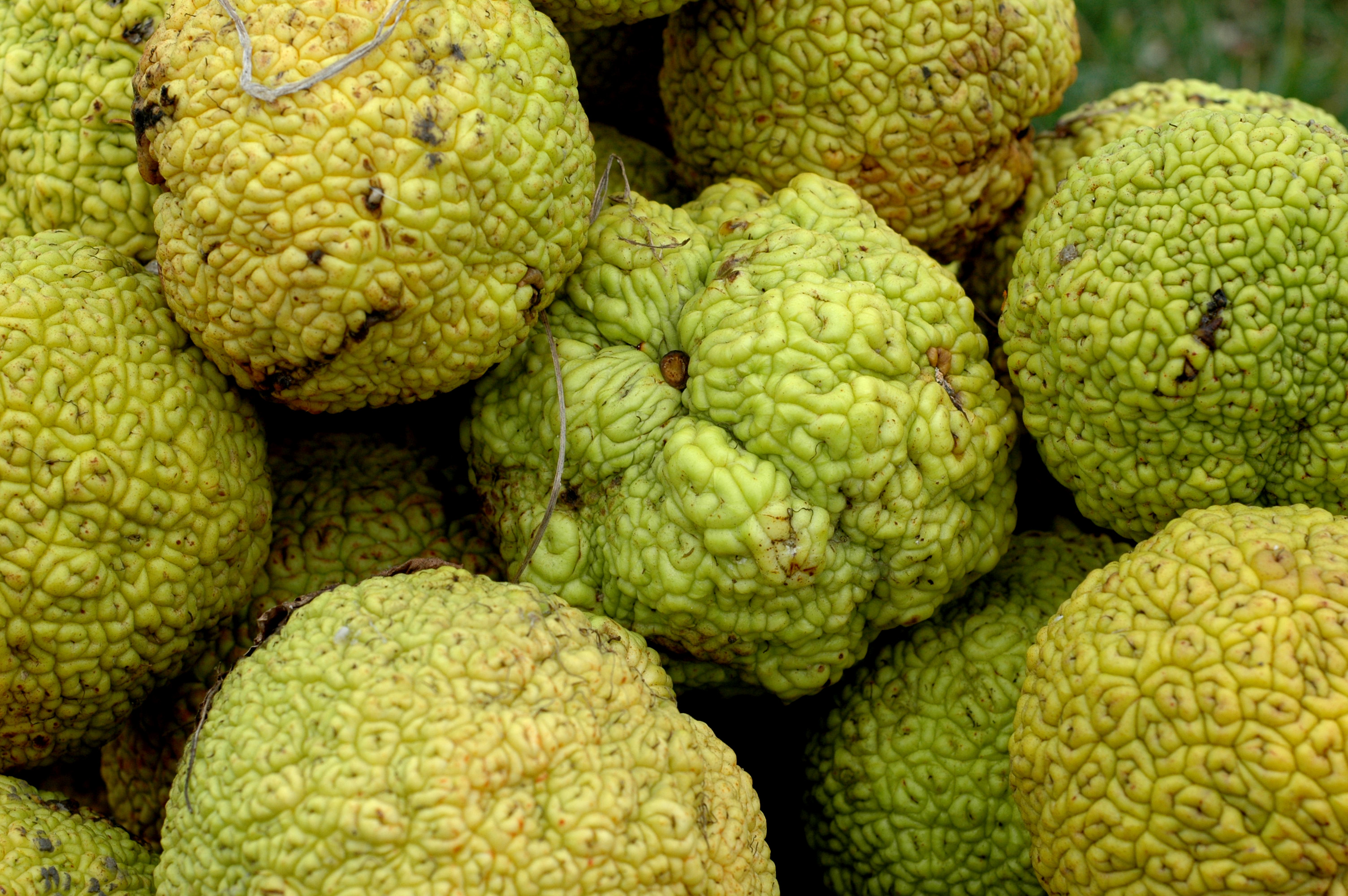
The Old Codger tells me that I should get a potato masher in the spring and ‘smash the mess up’ making a kind of slurry. Then down the back of the potato paddock I shall dig a straight long shallow trench and pour the seeds, pulp and water into the trench in a stream. Then we cover it with soil and see what pops up. I am sure the Old Codger will come down and wave his walking stick about to make sure we do it right. He is 93 and very sprightly. He calls a spade a spade, is an endless source of local information with a razer sharp memory for everything, except when he is meant to take a shower. He loves my fudge. 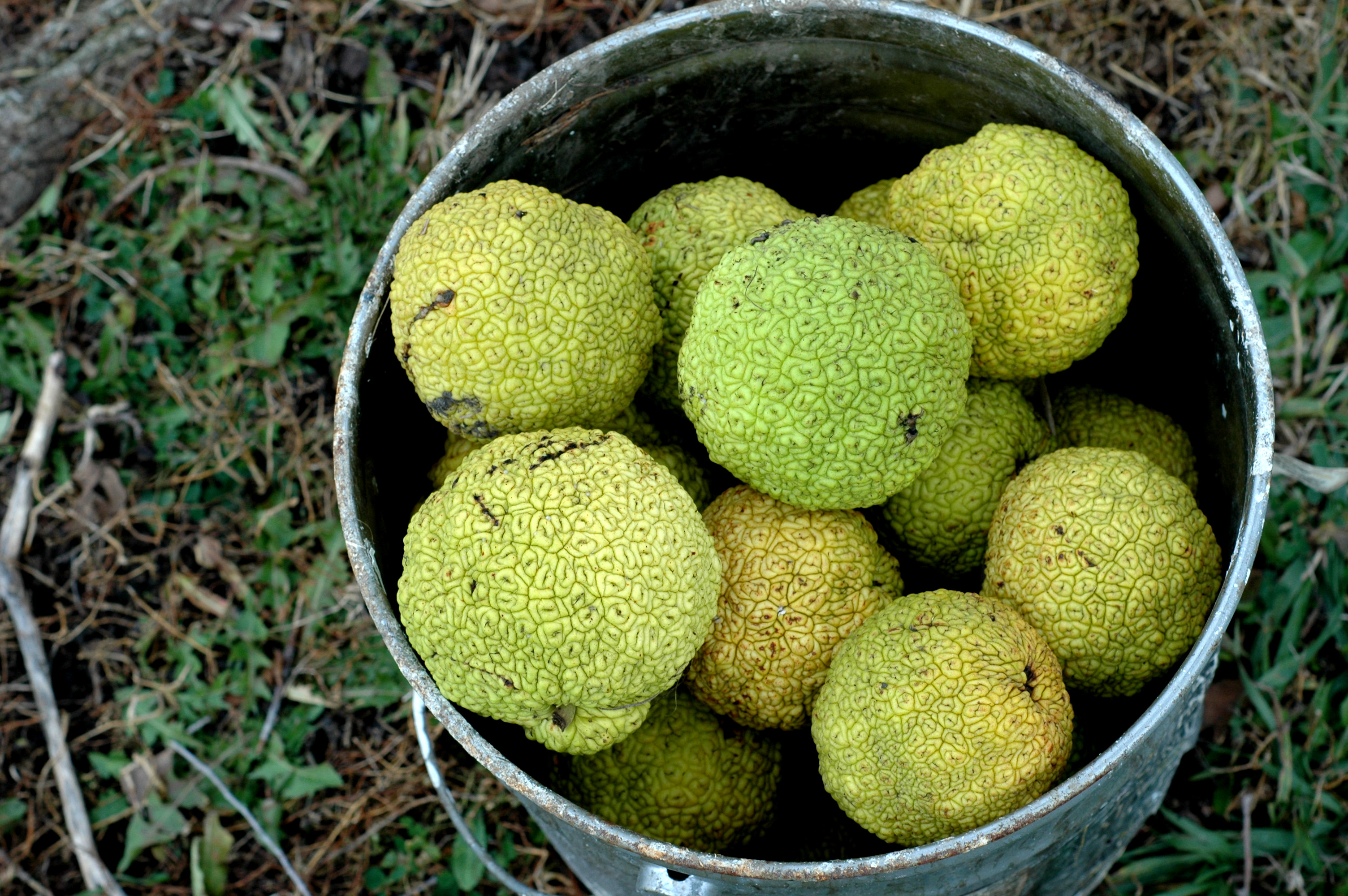
When the wood is young I can train the young canes into arches, creating a fast growing living fence that will control wind erosion, encourage critters (as the Old Codger calls them) and birds, create shelter and shade for the livestock and of course become a living fence. These hedges were used extensively in the midwest during the 1800’s, before barbed wire was used. My old friend told me that when he was young he saw huge steam engines come in and tear them all out. He said they tore down hundreds of miles of fenceline and hedges, making room for big horticultural monoculture. Sending all the native animals and birds looking for cover elsewhere. And setting the soil free to fly away.
He is thrilled to bits that we are going to plant a hedge-apple hedge again. Squirrels love ’em, he said. Don’t tell John that, I said.
c
 The Kitchen's Garden
116 responses to “Recipe for a hedge-apple hedge.”
Gosh, I think I’ve seen them once before and I thought they were a type of walnut? Guess I was pretty far off.
I don’t know Tammy, they do look kind of walnutty in a way, just imagine the size of the Nut in there though , wouldn’t THAT be great! c
how amazing to make a living hedge! I love the idea Celi 🙂 PS, mint keeps the mice away
Mint! Hmm, that is a good tip Tandy, dried mint or should I plant more mint closer to the house!?.. Though mine has to be in pots, my mint is voracious.. c
fresh mint in pots works, and near the barn for the lambs 🙂
Mint also helps the mother ewe dry up at weaning time. I shall plant more around the barn it can go crazy over there.. c
Interesting post and story. I haven’t known this hedge apple before. I learned and I saw now dear Cecilia. And I tried to search more about this apple. How interesting, once upon a time there were these Hedge apple trees in Istanbul and Bursa… But now we don’t have. By the way its botanical name is Maclura pomifera, I hope I didn’t make mistake. When I searched in my own language, I learned that we call them like that, “Apple of Bear” or ” an American Indian Orange,” or “faked orange”…. And as I learned that they come from Moraceae family… Dear Cecilia, once again I loved you so much, because you plant these trees for birds, squirrels, etc. This is so admirable. Thank you, with my love, nia
wow, thank you nia, where did the trees GO? and Apple of bear is a stunning name, we should make a list! that out for that research.. c
where did the trees go… I don’t know but probably we have buildings, roads, etc. instead of them… This is so sad of course… You are welcome and Thank you dear Cecilia, I learn so many interesting things through your beautiful posts. With my love, nia
A sustainable fence? What a great earth-friendly project!
I hope so yummy! It will certainly look after itself.. c
I’m standing and cheering here in my frozen suburban home way up in the great white north! Woot! We have many metres of fence around here and only a very few hedges of any kind. How wonderful if more living fences were to sprout back up (even here!) between and around our postage-stamp lots. Hooray for possibilities!
I bet this baby would grow up there too, and hubby can prune it with a chainsaw!!.. c
That sounds like such a great idea! My husband and I have a house in New Mexico. We will hopefully be moving there in 2012. His idea is to plant rosemary bushes along the property line. I think it’s a great idea! Good luck with your hedge!
A Rosemary hedge will be fantastic, they grow easily from cuttings and when you are grilling you can throw big hunks of rosemary into the fire to perfume your food.. I love rosemary. Good thinking.. c
Don’t you plant anything that will hurt or distress my cow! 😉
I know Jed.. It won’t be in her field.. and she has already told me that if she has a girl baby we have to call her Jedissa.. c
I love it!
(laughter)
I love this post! I didn’t even know what these multi-named Thingies were until stumbling on one sometime after landing in Texas, when of course I just had to look them up–lots of interesting, interwoven stories since their range is (as you note) now pretty widespread. I now know that they can float (why the pond-pitching is so enjoyable); that they have fantastic and flexible hardwood trunks for bow-making; that their chemical workings not only serve as a potential pest-resister (though I’ve seen beetles hanging about on them, so obviously not *all* bugs, if any really) but also are why the things aren’t edible. Not highly toxic, but they tend to give people/animals nasty stomachaches and such even in small quantities. Given that they apparently taste uninteresting anyhow, I guess it’s no big loss! But most of all, I like hearing about the excellent hedgerow-building capabilities these have. I’ve only seen them in their wild random positions, generally, so didn’t know about building a true living fence out of them as you describe, a technique I’ve greatly admired when done with other plants. Now I’m just sorry I don’t have a good spot on our little lot to put one in myself! I’ll watch yours develop with great approbation and a little envy. 🙂
They are fascinating aren’t they and all over the place with such a rich history. No eating them then! c
I’ve never seen these before, but now I’m wondering where I can find them. I’d love to plant a hedge in between the street and the sidewalk, and since it’s spiky and I’m naughty, this would be perfect.
Sweetie you ARE naughty! c
You come up with the darndest things… I just scratch my head and wonder how I ended up with such a boring little life here in the city. This is way too awesome.. the fruit looks like it came from another planet… it would make awesome pictures for your kitchen, espec the really zoomed in one.
They are certainly weird looking, I am looking forward to seeing young trees too, the only ones around here are very old and wild looking.. c
I have never heard of this plant. It looks amazing. I hope your new hedge does very well.
So do I Debra, all we need is a reasonable rainfall next year, so fingers crossed.. c
Those trees are ALL around my house! Except we call them mock orange trees, haha. So many names! They are an annoying mess if you have a lawn, since you can’t mow unless you pick those up, and the squirrels DO love them–they leaves piles of chewed up mock orange all over the deck. BUT, if they had a purpose like a livestock fence, that would be cool! And make them much less obnoxious.
And what would you do with all those oranges after you pick them up. Do you have a compost heap?.. c
One of my roommates does professional lawncare, so he takes them to the city’s organic matter dump with his regular grass clippings/leaves. Otherwise, no idea where I’d go with them!
handy fellow to have around!! c
Hi Cecilia. I have heard about hedge apples but never seen a photo before. How extraordinary! We had squirrels at the old house. They did love to chomp at the electric cables in the out buildings! Your “old codger” sounds like a real treasure.
Regards Florence x
I love this post. The history is woven in seamlessly. The final conversation snippet is perfect. The sense of bringing something back and making reparation to the land makes my heart sing. And of course, the apple-oranges are alive with character.
Celi, I am going to send permission slips home with children today so their parents can give the nod to sending the bee poems to you. They are superb! I think you have my email address. Would you like to send me yours via that so I can forward them to you? I’m so excited that you will read them.
I shall email you this morning, how exciting.. c
Interesting C! The only uses I knew them to have was, like you said, keeping mice away. Thank you for the education!
Oh, you are most welcome Country Bumpkin!! c