

We are going to sow a sustainable living fence in the spring. An old fashioned hedge-row. The hedge will be made from Hedge Apple. Early settlers planted the Hedge Apple (Osage Orange) which is in the same family as the Mulberry, as hardy hedgerows and the trees can grow to 50 feet high if left unpruned. The tree is very thorny and when pruned to be quite dense it is very effective as a livestock fence. Horse High, Bull Strong and Hog Tight my Old friends tell me. Well, we will see what Daisy says about that. There is an old wives tale that the actual horse apples repel mice and insects, and there was a time when the apples were lined up around the outside of the house to keep the home pest free. No-one can tell me if this was actually a useful practice. I think I will leave that work for the cats.
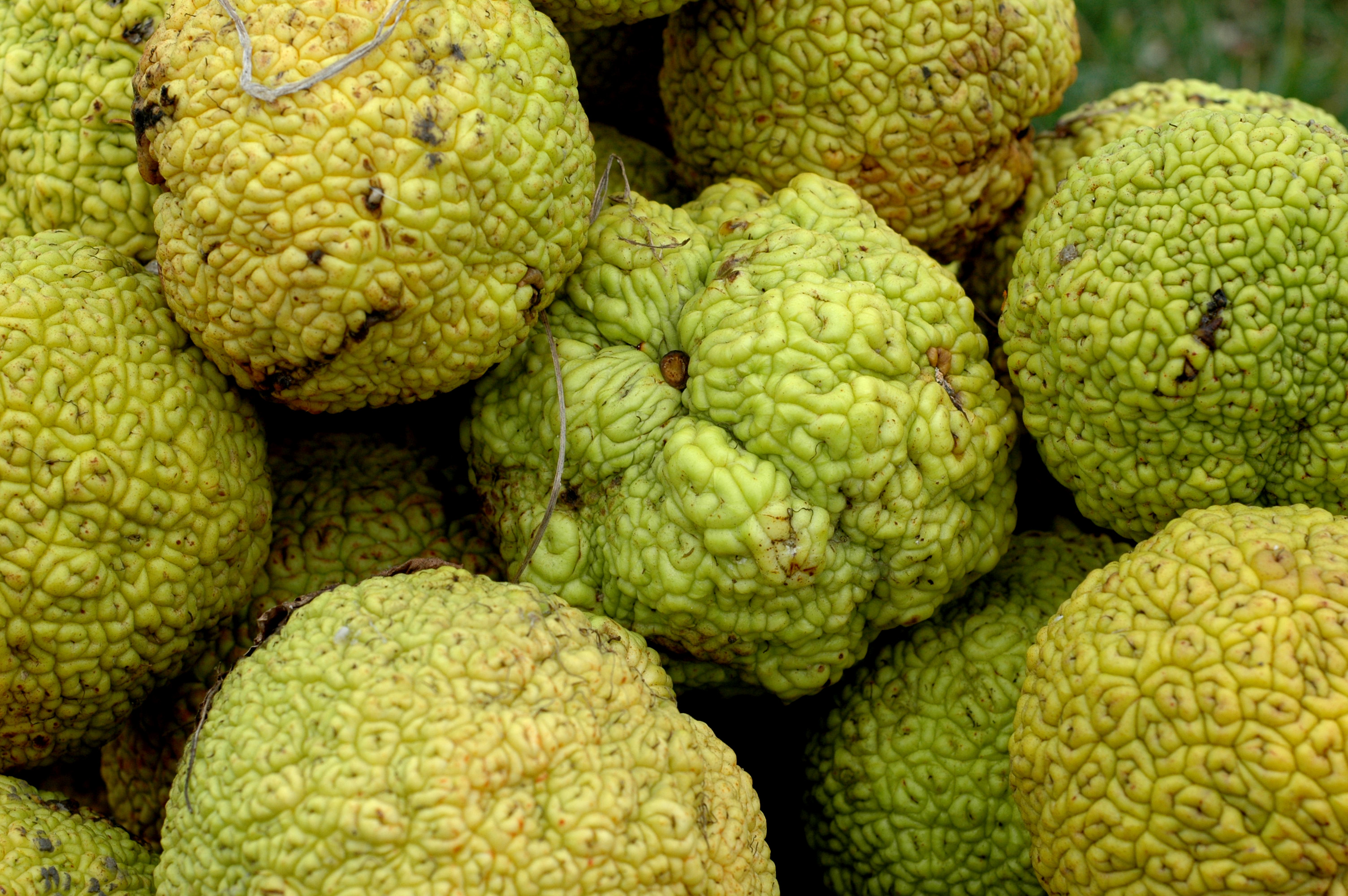
So with direction from the Old Codger who I visit twice a week, (everyone needs an old person remember and he is mine) I have gathered the hedge apples. They are called oranges. This gets very confusing. In fact they have many names – Monkey Balls, or Horse Apples among them. These are very old trees and because of their thorns they are no longer popular. But they have dense hard timber, good for fence posts as the wood does not rot and even further back the Osage Indians used this wood to make their bows. That old.

I have filled two big buckets with the strange alien looking oranges. The buckets will be left outside beside the barn for the whole winter. They need to sit out in the weather. They will be rained on, snowed on, frozen, thawed and frozen again and by the spring thaw they should have started to go nice and mushy.
The Old Codger tells me that I should get a potato masher in the spring and ‘smash the mess up’ making a kind of slurry. Then down the back of the potato paddock I shall dig a straight long shallow trench and pour the seeds, pulp and water into the trench in a stream. Then we cover it with soil and see what pops up. I am sure the Old Codger will come down and wave his walking stick about to make sure we do it right. He is 93 and very sprightly. He calls a spade a spade, is an endless source of local information with a razer sharp memory for everything, except when he is meant to take a shower. He loves my fudge. 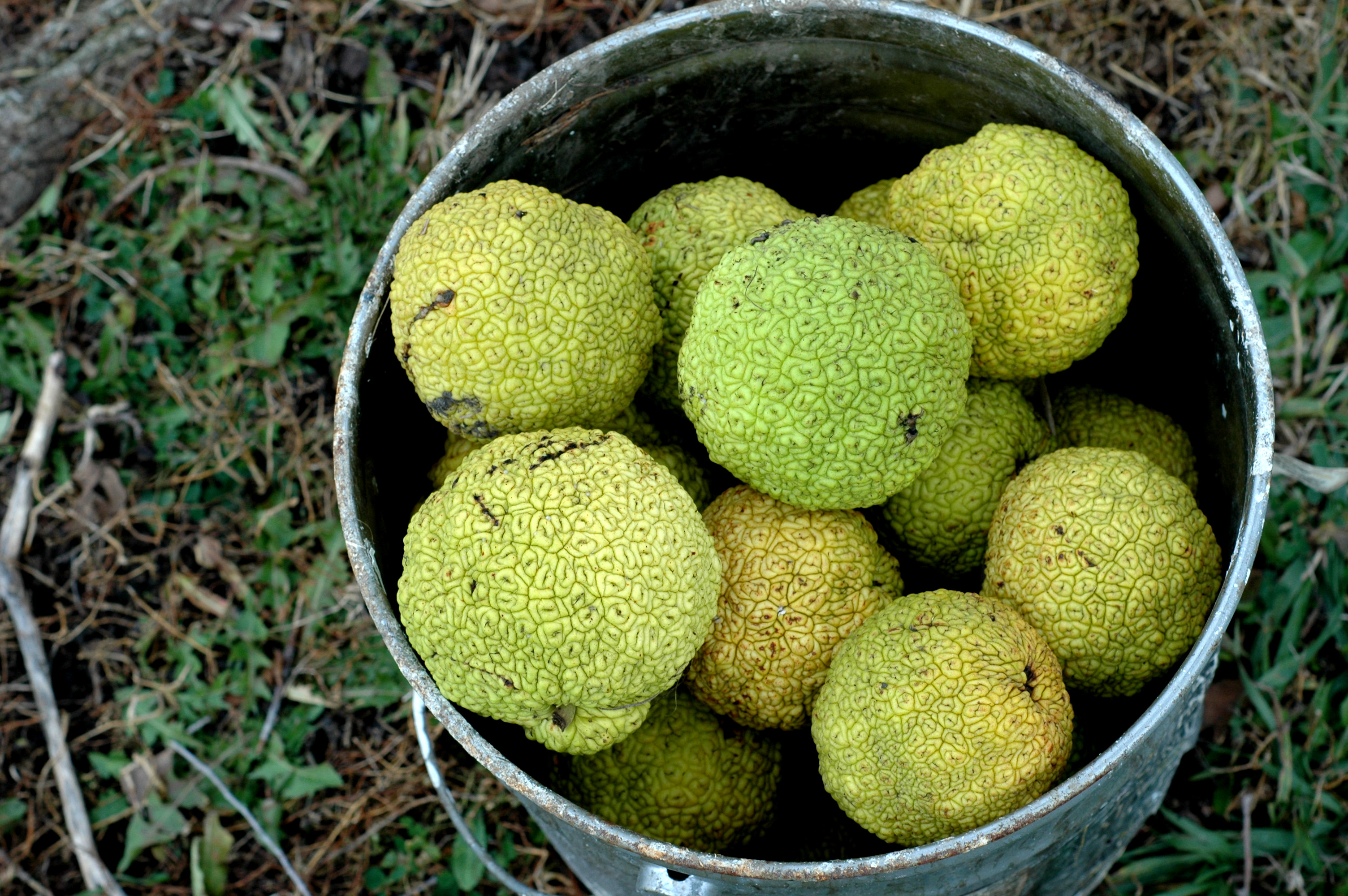
When the wood is young I can train the young canes into arches, creating a fast growing living fence that will control wind erosion, encourage critters (as the Old Codger calls them) and birds, create shelter and shade for the livestock and of course become a living fence. These hedges were used extensively in the midwest during the 1800’s, before barbed wire was used. My old friend told me that when he was young he saw huge steam engines come in and tear them all out. He said they tore down hundreds of miles of fenceline and hedges, making room for big horticultural monoculture. Sending all the native animals and birds looking for cover elsewhere. And setting the soil free to fly away.
He is thrilled to bits that we are going to plant a hedge-apple hedge again. Squirrels love ’em, he said. Don’t tell John that, I said.
c
 The Kitchen's Garden
116 responses to “Recipe for a hedge-apple hedge.”
My father grew up on a farm in Sycamore Kansas. They had hedgerow fence posts that were from some time in the 1800’s. The last time he was out there he brought back one of the fence posts. He gave it to me and for Christmas, my husband had it made into a floor lamp. The carpenter drilled through it for the cord and mounted it on a base. He said he would never do another one; the wood was so hard, it was almost impossible to drill. My lamp is beautiful and so very special! My father, my old codger, was tickled that we would bother with his old piece of wood.
Hi Lynne, what a fantastic idea to make that into a lamp! It must be beautiful! c
We have used the hedgeapples to keep spiders away from our house. They work great. A friend brought be some years ago and I would like some again. Wonder if you live near Flint, MI?
Thanks,
Judy
No we are in illinois and miserably our hedge did not survive the drought, however i am going to try again.. c
I’ve ask around and I can’t seem to find any horse apples. Is there anyway someone could mail me a couple? I would of course pay for everything. It’s a health issue. Thank you!
Sure, jimmie, I am going past the big hedge today – I will have a look, but it was heavily pruned last winter.. so I am not sure if I will find any – can you email me on celima.g.7@gmail.com and I will let you know.. c
Hi,interesting story. Sorry they didn’t make it. I’m intending to grow some from seed as grafting rootstock for a relative, the Che tree from China. It makes an edible, reddish colored fruit and does better on the Osage Orange root system, so they say. The Asians use this plant for all sorts of healing properties.
John grew more this year from the seed apple – he just pulled it apart and placed the seeds into pots of earth. They did very well! I will look into this Che tree sounds interesting.
how long does it take for a hedge apple tree to grow and produce hedge apples?
I don’t know – the ones on our property are very old. I would say at least five years? But remember to grow more than one so they cross-pollinate.