

Kind of a spooky dawn this morning. The haze has created this effect I suppose. The only green in our landscape is the genetically modified crops but even they are beginning to curl up in the heat of the day. 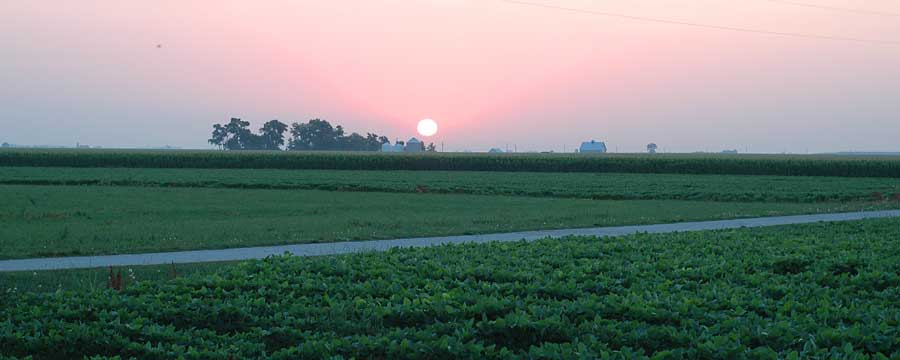
When bees encounter very high temperatures they use a number of systems to cool the hive. They like to keep the hive at a temperature of 90-95 (32-35C) all year round. Normally they regulate the temperature by fanning in the summer or huddling in the winter. When the temperatures are in excess of 100F then they order extra water collection. In fact many honey collectors will be sent for water instead. The collected droplets are laid in a line just inside the entrance to the hive and rotating squadrons of bees are sent out to fan air across the water line, with another set of bees inside fanning the cooler air up into the hive.
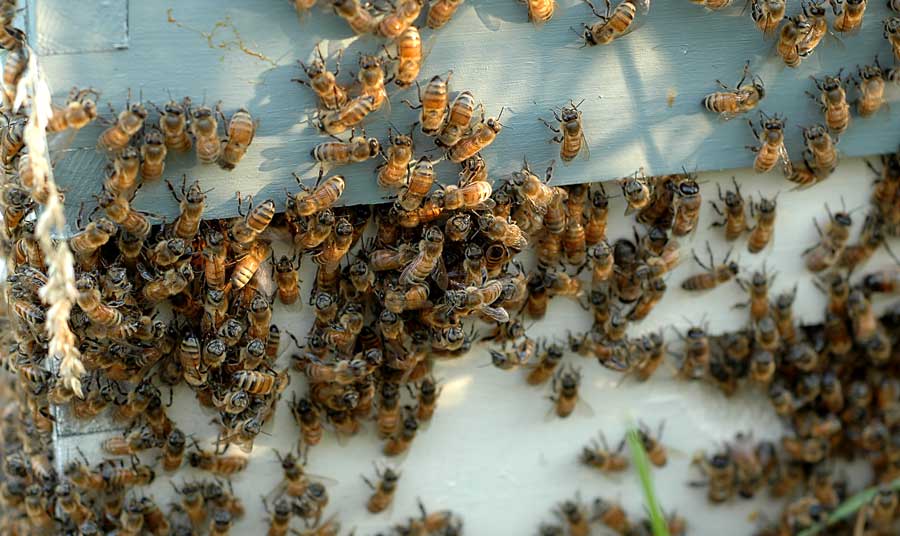
If you put your ear to the hive wall you will hear the noise of thousands of wings, it sounds like the roar of a small motor revved to the max. If it is still too hot many of the bees will crawl right out of the hive and loiter about at the entrance, freeing up space in the hive for the air to flow to the brood. This causes overcrowding at the nightclub doors, and they get in the way of the fanners, so the bouncers send the crowd out into the street and up the walls to cool off. Creating a thick gathering of buzzing bees on the outside of the hive. This is called bearding. Bearding is common in the heat. Bearding has nothing to do with swarming.
To help the over heating hive I need to make sure there is plenty of water around, and that the hive is vented with my stick at the top. The rest I leave to the bees. And hope the temperatures drop soon.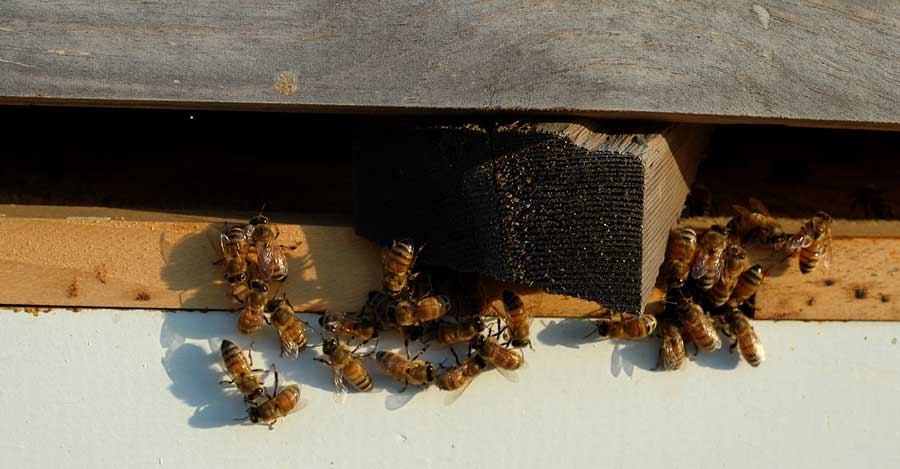
When I have the vents open they order extra guard bees to make sure there are no intruders.
One of my hives has a heaving mass who hangs out on the shaded side of the hive, the wall is thick with them. They are bearding normally. The other hive has a scattering of bees all over it and they are all facing downwards. I did not notice how they were arranged until I processed the image.
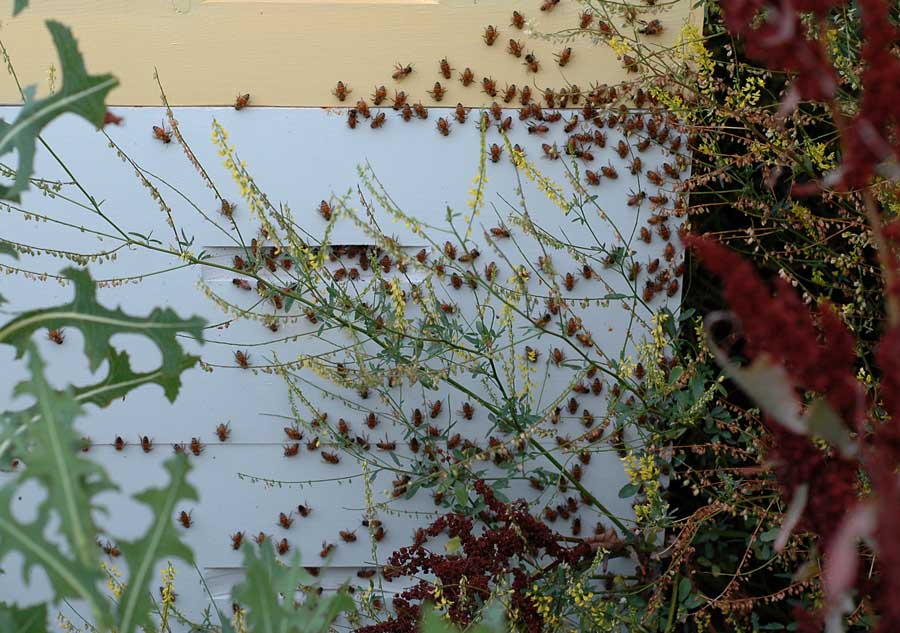
This can mean that there has been a mutiny and a large portion of the hive is considering doing a runner. These girls have been sent outside to wait. They are the rabble in the streets waiting for the order. They might be going to swarm due to overcrowding. I am sure the heat contributes to this. So this hive will have to be inspected today. Which is pretty mean as the fanners and the droplet collectors will have regulated the temperature in the hive and when I open it up I am going to disrupt all their hard work and let the hot air in. 
Good morning. My weather man tells me that we have one more day of this heavy hot weather. Let’s hope so. The prolonged high temperatures are beginning to wear on the animals. The Baby Bobby Blanc is being fed extra water through-out the day as he has become unusually lethargic. The Big Dog who is quite old has become very hobbly and wobbly on his feet and is not eating very much and Queenie had to be prodded and scared up yesterday evening after lying down all day. Her mouth is open, panting and she is dribbling saliva. I mist her with the hose during the day and I did get her to move out into a new field last night with the others. But I had to point the lemon grass fly spray at her to make her move to the water trough. She hates the fly spray. Why that cow is having trouble in the heat I do not know. The others are fine. Daisy as you know is giving more milk than ever. But losing weight. We are all losing weight.
One of the big pigs is having the same trouble but he will lie under the sprinkler cooling off. So he is a bit easier to manage. Once again though they are not keeping up with their feed. The only ones thriving in the heat are the chickens as they go around cleaning up everyone else’s uneaten expensive grain and hanging out under the pigs sprinklers, ruffling their feathers and chatting.
No-one eats in the day time when it is this hot. All the smaller animals and birds are getting extra milk and eggs to compensate. The sheep and cows are being fed alfalfa in the shade.
So today will be another day of gathering water and fanning for the bees and laying under the trees for the large animals and dragging hoses for me. We are managing so far though, our systems are working. One more day.
I hope you all find something lovely today. Whether you are cool or hot.
celi
 The Kitchen's Garden
94 responses to “Bees in the Heat”
Even I can’t eat as much in such heat, I hope you all can ride it out. Eerie looking dawn. 🙂
What clever bees 😉
Morning Mad! c
It’s finally supposed to be down in the 90s this week. It’s been way over 100. Sounds like your animals take it better than we do!
I had never realised heat affected bees so much! I have just given the family a lesson in bee husbandry based on this post! Amazing pictures too…that skyline is beautiful.
Stay cool 🙂
i fixed it for you kate.. and yes i am under the fan as we speak! c
Hi Cinders…I kind of agree with the crazysheeplady..shouldn’t you ought not to disturb them and let them figure it out…as only they know how to do that, nature knows best…more harm might be caused than not if you disrupt their system…maybe not…what do I know…I am not a beekeeper but just makes sense to leave them bee! 🙂
I knew you were a fairy farm mother…keeping all creatures on the farmy as cool as hydrated as you can!!
Great photos…even in all that heat!! Stay cool yourself…relief is on the way!! How do you sleep at night…do you have fans or just head to the basement??
It is a good thought and thank you for bringing it up but I do not want them to swarm. Then more than half the hive will fly away into spray country. Then i am left with a tiny number who will probably not survive the winter alone. these are italian bees and domestic bees will not survive in the wild here it is too cold, and there are no forests to shelter in,and the surrounding horticulture is not a good place for a bee to try and find a home. So if they swarm then i will have to go and rescue them, then build them a new house and then wait another year with two tiny groups of bees. It is true I cannot inspect today as it is too hot. But we may also have an infestation from moths or something happening in there. There are many reasons why it is my responsibility to look after them. Actually tomorrow we will link back to me capturing a swarm.. that will be fun for you to see and will illustrate what i am saying. it is good to ask these questions though christine.. thank you for that.. c
We all go a it bonkers in the heat, no chance of that in NZ at the moment, 5C this morning in Muriwai which is very unusual, sunny though…it’s going to be a stunning day.
NZ does that in the cold doesn’t it.. cold and clear and so crisp! beautiful.. c
What fascinating information about bees, and I hope they aren’t getting ready to swarm…I don’t know much about them, but I know that’s not good. RE the post notification problem, I have noticed twice in the last two weeks that you either fell off my reader, or my email subs, or both and had to resubscribe both. At the moment you are showing up on both, but that’s the first time in quite a while. I just posted about fighting heat with heat in food, but am thinking at 104 for so many days and no air…you don’t need more heat, that’s for sure. May relief come soon!
This was so fascinating g to read today..it almost felt like I had picked up an old journal from a homesteader going through drought on the land.. Long long ago. I loved your writer’s voice today!
Also.. I will pray for Rain!
I wish you a break in the heat soon. So fascinating with the bees.
That is all so interesting about the bees. I knew how they kept warm in winter, but not about their winged air-conditioning system in summer. They are so resourceful – as are you, thinking up 101 ways to keep your animals comfortable and thriving. Hope it cools soon.
This may sound ridiculous, but do you still need to smoke the bees to extract the honey when it’s so hot outside?
that is not a silly question, I don’t want smoke in my honey and to extract the honey I want all the bees to be out of the way, so i wait until it is a bit colder, then when they will go down to cuddle up and keep warm I block them out of the honey layer.. it is too early to take honey.. the early honey always crystallises, in my experience.. I will lead you through the process later in the year.. if I want some honey earlier, i just brush the bees off..and nick it then gobble it up just for me c
That is so interesting about bee activity. I’m glad to hear cooler temps are on the way. We have another day of it, at least. Finally, there is rain in the forecast.
Longtime reader,first time poster.There is a great book on Bees called Bumblebee Economics by Bernd Heinrich.This one is more technical than his usual work but it provides a wealth of info on Bees.
Thank you John, i shall check it out. I am always trying to learn more. The bees have a fascinating world! c
Fascinating stuff. What has happened to the pre-swarmers since you wrote this?
They have done nothing.. too hot I hope.. we will see tomorrow.. c