

Soap is not hard to make as long as you get yourself very organised before you begin. It only takes a couple of hours to make a decent batch of soap. I used lye, lard, coconut oil and water, then added lavender for fragrance. After reading all the sites you sent me to, this weekend I began the practical research in making Lavender Soap for Charlotte.
 First I made a Cold Process soap. I added the lye to the water and stirred it then added this to the fats and stirred that with the stick blender, it came to trace very quickly (Trace is when your stirring stick leaves a trace in the pudding like mixture) so I poured it into the mold and wondered why it had been so easy. After reading a number of other recipes I realised I had done piles of stuff wrong. I had forgotton to take the temperature of the lye. I added lye to unmelted lard. I had forgotton to cool the lye first. I had forgotton to cover the soap afterwards so that it stayed hot to cure (though I quickly rectified this once I realised).

(Surprisingly the next morning the soap had forgiven me and it was hard enough to cut into slices) Much to my amazement I had made soap.
There are two ways of making soap, both begin the same but end differently: Cold Process Soap and Hot Process Soap. I had elected to start with the Cold Process as it looked simpler. Making Hot Process Soap means that after adding the lye water to the lard and stirring it to the trace stage, you then cook it, so with my second batch I did this in the slow cooker.
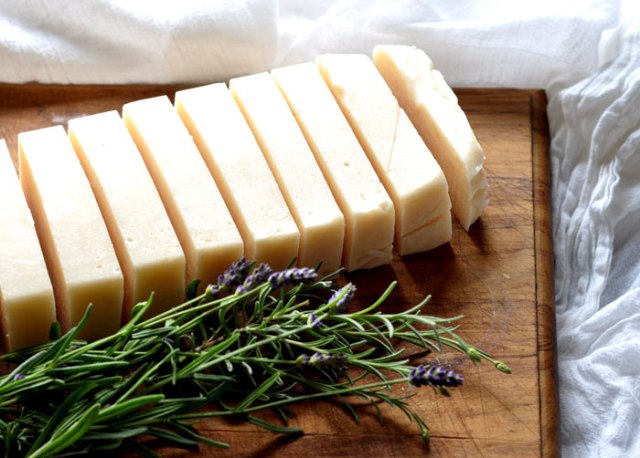
And once again I made soap. I got the recipe for this one from chickens in the road.

I chose to add lavender instead of vanilla and cinnamon (we all know how I feel about cinnamon) and it came out beautifully as well.
So either soap making is really not as hard as I thought or I have used up all my beginners luck.

Just be careful not to inhale the lye water, and mix the lye into the water not the other way around. And have everything measured and in order before you begin.
I used shoe boxes lined with white plastic bags for molds.
As I have no plastic jugs and bowls, glass and stainless steel is fine. Everything washed up beautifully in the dishwasher.
Make sure to cover the soap in its mold straight away with a piece of cardboard then with old sweatshirts and towels. The first stage of the curing is a hot one and it needs to stay warm as long as you can.
The bars of soap are now resting in the cellar to cure. I have about forty creamy lightly scented bars. For the Cold Process the curing may take up to 6 weeks. For the Hot Process the soap will be ready to use after only a few weeks (though some people use them straight away) as the heat from the cooking escalates the curing process. I am instructed to turn these every few days so they cure evenly.
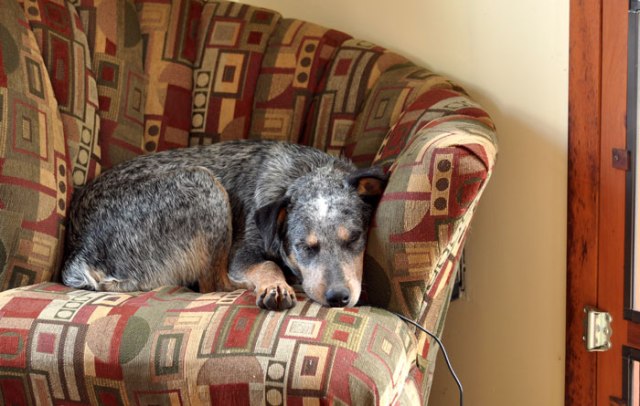
I was so focused on my soap making ventures that I did not notice Boo the Bad very quietly creeping into my reading chair for a quick recharge.
Now that I know the basics I am going to make more soap. Designing a soap for each of my children and their families as their Christmas presents. There is excema in our family and lard soap is supposed to be very good for the dry skin.
After the soap I spent the rest of the weekend making bread and ice cream and tomato sauce and the usual things.
But I am as proud of making this soap as I am of growing my own apples.
Have a lovely day.
Your friend on the farm, celi
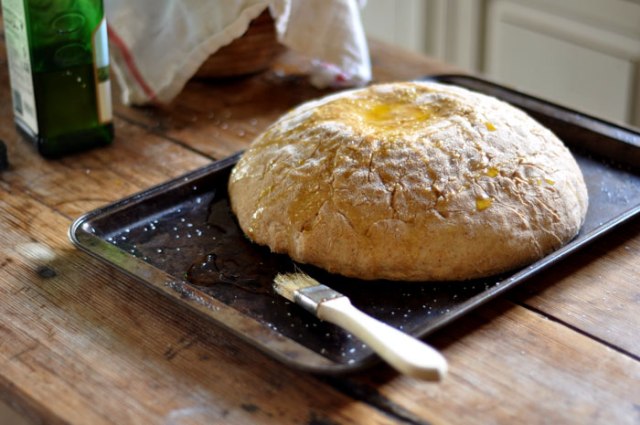
ps This is bread, not soap. No mixing the two up!! Good morning!
pss, (later in the morning) just found this link with some really good soap making info: 4 steps to making soap. Worth a look.
 The Kitchen's Garden
96 responses to “Making soap for the first time”
I think you will find that making soap is a wonderful thing.
First off: No lye, no soap. Lye plus oil/fats equal soap and glycerin. Period.
Lye from wood ashes is Potassium chloride
The white kind is Sodium chloride. The two are NOT interchangeable in your soap recipies.
If, after your soap cures, you touch your tongue to the soap and it zaps you….it is not ready and will be harsh.
Try Brambleberry.com for tutorials and supplies. Also MMS.com has a great lye calculator.
Olive oil makes Castile soap which is very mild.
Soap makes much appreciated gifts and is so much better than the supermarket stuff, which is usually not soap at all.
I half expected you to end with a story about Boo running round the garden with soap in his mouth like a dog with hydrophobia 🙂
Ha ha ha ha!!!! 😀
I almost forgot. Lye is a caustic base, not an acid. The oils and fats are the acid. Pretty interesting stuff. Looks like you are off to a flying start and am looking forward to seeing what you do next. Since we have been using handmade soap our skin looks great. No more rashes or irritations from store bought. It is a wonderful skill to cultivate. I admire what you are doing.
Thank you Emily. Good info. My next one will have oatmeal in it, if you are till reading i have a question. There is your basic recipe of oils/fats and lye and water. Then there seems to be a muddy area around how much fragrance, or sugar, or oatmeal or whatever to add (at the end) . I have gained the impression that the additives are not part of the actual soap equation.. is that correct. e.g. if i choose oatmeal instead of sugar would it be the same amount? If i just choose not to have coffee grounds in there would it still work the same? Does it matter how much of the fragrance I add? You can tell I have done a lot of reading. But have piles to learn yet.
You are right, the additives are put in just before trace and are not part of the soap recipe. Some essential oils accelerate trace and can actually sieze your soap. (not a good thing). Oatmeal and coffee will thicken it, depending on how much you use. You don’t need much…a couple of tablespoons to start. They can make your soap really scratchy. A lot depends on how much your batch weighs, too. For about a 3 pound batch of soap I usually use 1 to 1.5 oz of Lavender essential oil…added at trace. You want to put enough in so the fragrance doesn’t fade in a few weeks. I have never put sugar into my soap….read something somewhere about that, but can’t remember what, exactly. You can Google it. You can emaill me if you have questiions.
BTW, lye is sodium hydroxide. Don’t know why I said sodium chloride (table salt). Must have been a senior moment, lol
What a stunning first attempt, Celi! Happy to hear it worked so well! The bars look very beautiful and professional!
Go and continue doing it – it’s great fun and it’s – unfortunately – becoming addictive. 😉 I’m making soap since appr one year. It’s a lot of fun – you can make amazing swirls with cp-soaping. And I realized that the self-made soap is a lot better for your skin than industrial soap.
Reblogged this on Damn the Matrix and commented:
Been wanting to have a go at this…… a friend of mine in Tassie has goats whose milk she uses to make soap..
Your soap looks fantastic Celi, congratulations that it worked out so well. My husband’s family are a long line of soap makers, since the 1800’s but they used industrial sized machines to mill the ingredients and push them through forms. Sadly the business did not survive the early 2000’s due to several customers going under but soap is still in our blood. As our wedding trinkets we had the entire wedding party into the lab in the plant to make 200 little heart shaped soaps with our name and dates engraved in them. I still have a couple left. I love that you used lavender, one of my favourite scents.
Hi Cecelia,
Welcome to the wonderful world of soap making. I’m into aromatherapy and love working with essential oils. Some essential oils like lavender, sandalwood, marjoram, frankincense, myrrh, rosewood and chamomile are soothing. Others like peppermint, spearmint, eucalyptus and lemon oil are energizing. Don’t hesitate to experiment as I’ve been doing this for decades and have never had a bad batch. I also make my own bubblebath and facial masks as well as soap. If you poke around in my personal blog you may find some recipes that interest you.
I made soap years ago with a friend, but I mostly just followed along. I remember how proud we felt at the results. I hadn’t thought of that in years, and you’ve given some good instruction, so maybe it would be something nice to do with my daughter. Your end result is just beautiful. The bread is VERY tempting! 🙂
Those bars of soap do look very professional: beginning of the ‘Charlotte Range’ 🙂 ! Practical me just wondered – can one really get all the muck off the stick blender? So the next soup or cake does not have a tinge of lavender flavour 😉 ? Oh, Boo obviously found the most comfortable seat in the house, bright guy!! And hope you had a really good time with your visitore on your ‘day off’ . . .
It is soap so i just pop it in the dishwasher, it is easy to get off metal and glass, not so with the plastic of course, but i have no plastic things so that is ok.. The powers that be do advise that you keep all these utensils separate for soap making. c
Yup, that does make sense . . . . had not thought of things in the ‘soap’ sense, just the ingredients 🙂 !
C. the photos of your soap are just beautiful, as is the bread and of course that loveable Boo in your chair, which btw…I have one with a similar pattern and colors! 🙂
That does not suprise me at all!! Laugh!! Lovely.. c
Coming in at the end, I can see how the whole Fellowship is rejoicing with you at this success. Congratulations on this fine soap-making. It must be so satisfying for you, and we all love it too (even though it can’t be eaten!)
Way to go, Celi! I sure didn’t take you long to figure out soap-making. It’s a good thing you haven’t any little ones about, though. Your soap looks like a fine white chocolate. Heck! I’d have to watch myself! 🙂 Boo in the chair cracks me up. If given the chance, Max will do the same. It’s forbidden fruit.
Very impressive…
Love the soap although I thought it looked like nice blocks of cheese. A friend of mine has been making soaps which are perfect gifts, I especially love the lavender. Boo kind of looks like he’s trying to be invisible – I’m surprised you saw him with his doggie invisi-shield up.