

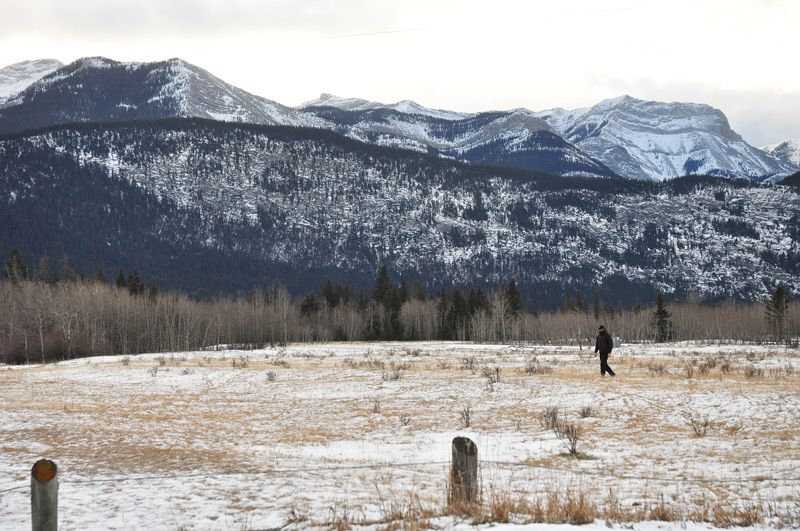
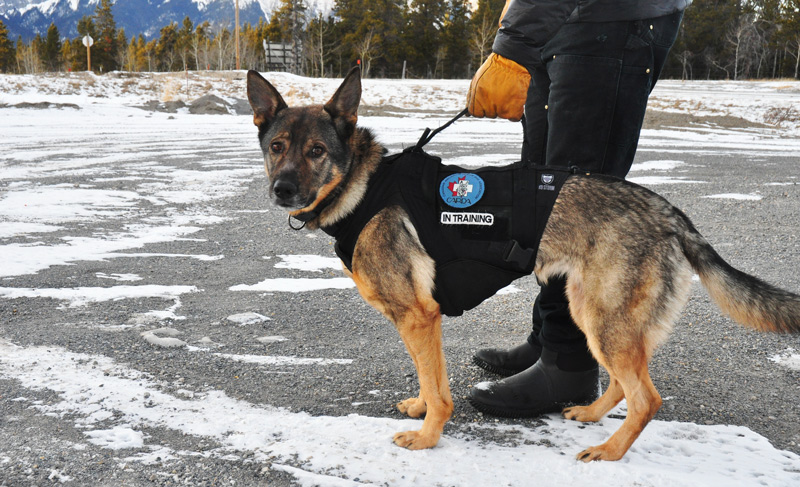
Good morning everyone. As promised here is a little about Training a Dog to Search for people buried in an avalanche. There are other aspects to an avalanche dogs training but Search is the central one.


I will hand you over to Logan. To explain a few of the steps.
To begin. Every time you train – the dog is dressed in her harness to work.
- Master Runaway. Handler runs away from dog while dog is being restrained by assistant. This is because the one person that the dog will want the most is their handler. Once the handler has run away we say SEARCH and then release the dog. Once the dog has found its master they will be presented with the rag, the dog will then grab the rag and play, being pulled from side to side by the handler. This ragging game is the foundation of all of the training for our profile, we select dogs that are predisposed to RAGGING so they love the training games.
2 Next is Stranger Runaway. This is the same game but now with a stranger, the stranger runs away , we say SEARCH, the dog locates them and then engages in the ragging game. This is teaching the dog that he can find someone he doesn’t know and you can have super fun awesome time.
3 Then we Delay the time after the person (we call him a Quarry) has run away and before you release the dog. This is saying to the dog, we can still play this super fun game but it’s not until I tell you to SEARCH. This reinforces the search command.
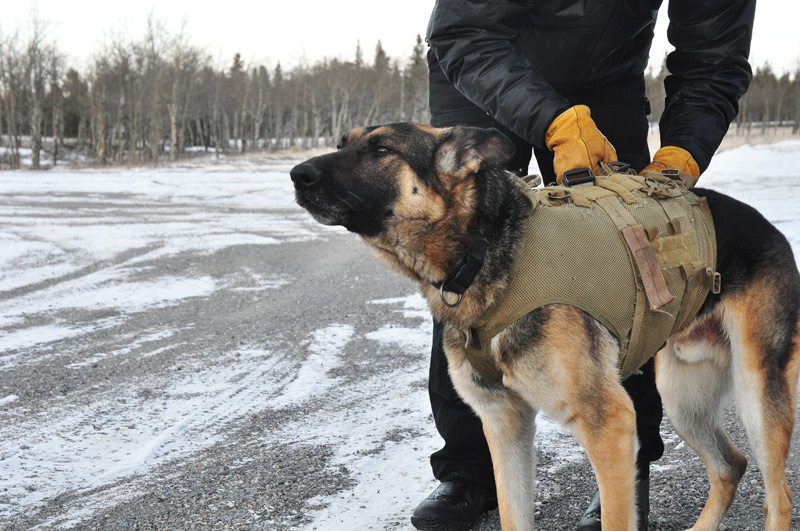


4 Next is Blinds. This is where your quarry is already out there when you get to the search site and you release the dog with the “search” command and then they find the Quarry and have the super awesome funnest time ever. This is telling the dog you might not know the person is even there but since I’m telling you to “search” you will have a super fun awesome time finding someone anyway.
5 Then we go to Quincys. This is where we build snow caves and have the Quarrys do runaways into the cave. This reinforces to the dog that there can be fun times UNDER the snow. Later we pile snow in front of the door. The dog digs her way In. This says you will have to dig for your fun time.
6 Next is The Leap. The quarry is hidden far away and in front of them there will be a big backpack and a smelly rag attached to the backpack. In this situation we release the dog and hope that they become interested in the backpack with rag attached. As soon as they approach it they are encouraged to engage with the rag. Once they pick it up we approach the dog and rag (play) in the same manner as a Quarry did. This is telling the dog, it doesn’t have to be a person! You can find an inanimate rag and have fun with that!
7. Then we hide the RAG in the cave. Then we bury the rag in the snow. So now we have a dog who can find a human smelling rag buried in the snow. All we have to do next is to extend how long they can search for, how many articles they can find and how deep they dig for the articles.
There is also training for Obedience, Retrieve, Travel, Helicopters, Long Lines and many other avalanche related skills.
This training can take 2 to 2 and half years to complete. And every avalanche dog trains every day for the rest of her life and has to pass the validation obedience exam with the Royal Canadian Mounted Police every year so she and her Handler can work in an emergency.
Our EXAM for the Searching component is for the dog to find 3 articles buried 75 cm deep in a 100m x 100m square area within 45 minutes. 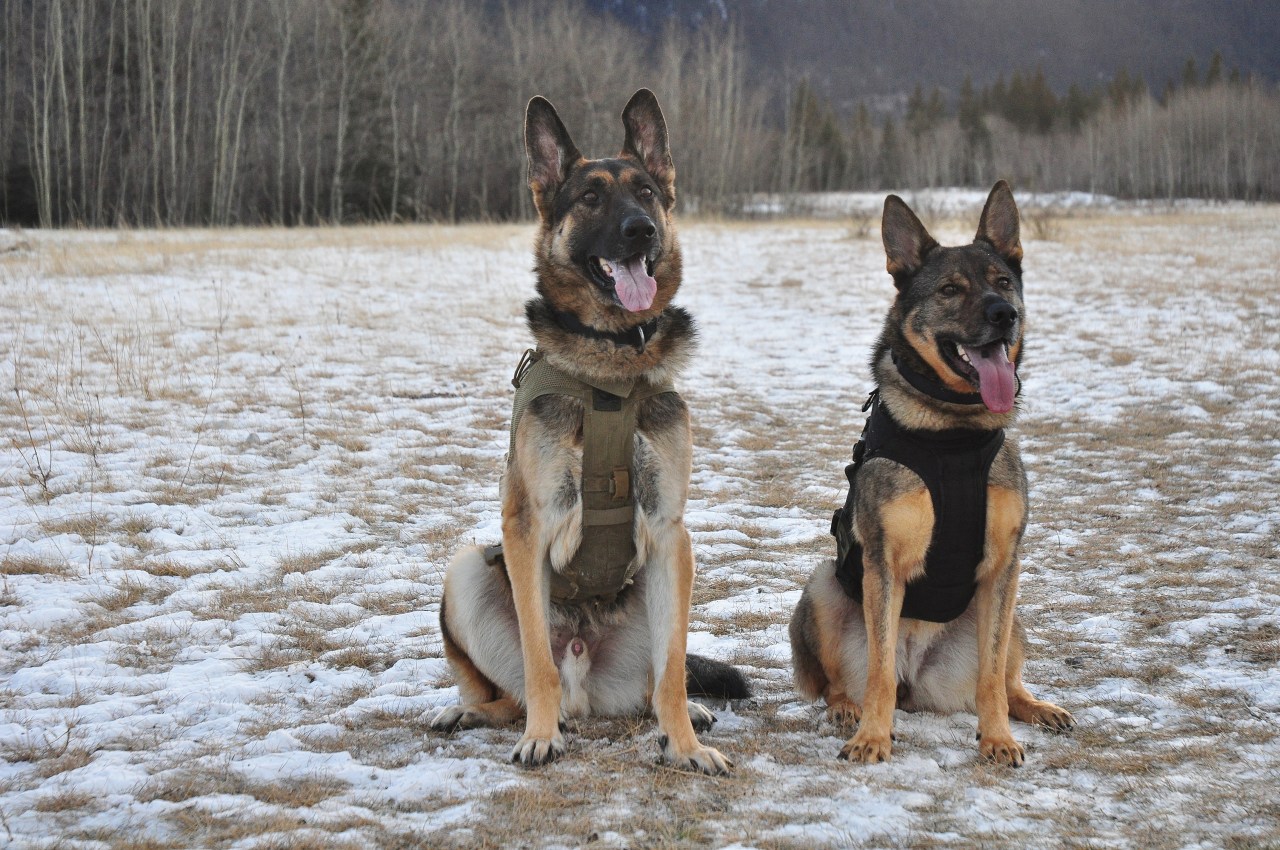
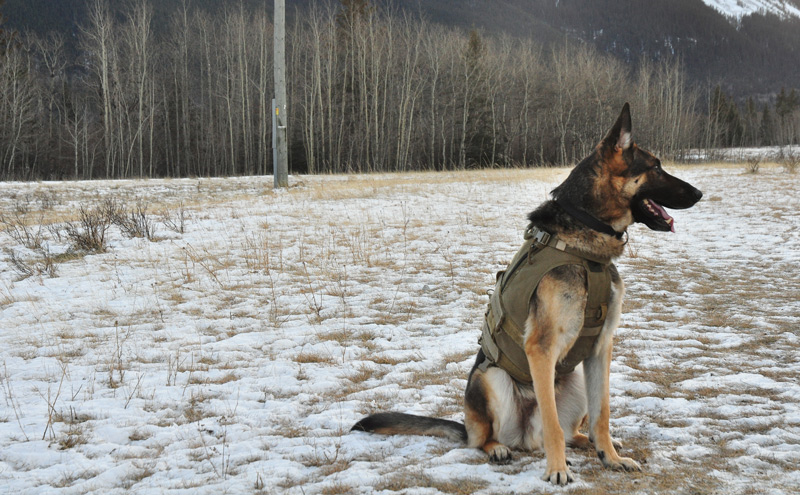
Cai and Ferra. Cai: Retired avalanche dog and Ferra: Avalanche Dog in Training.
Good morning if you have any questions Logan will answer them for you in the comments today. And tomorrow I go back to the farm but I will have time to post one more time from here before I go.
I hope you have a lovely day.
Love celi
Here is the Alberta Avalanche Dog Training Facebook site and the go here for the Canadian Avalanche Rescue Dog Association in case you would like to become one of their supporters. Like many other essential services they are a volunteer organisation.
 The Kitchen's Garden
85 responses to “Avalanche Dog Training: Search”
I am curious, how did you come to this profession Logan? Perhaps your wonderful mom has shared this on her blog at some point but to be honest, I am too lazy to search out the answer 🙂 It seems evident that your dogs must love what they do.
HI Deb, no I have not discussed this on the blog – a good question though – I know the answer but later when i see Logan I will get his words.. c
Am I right in saying these two are German Shepherds? Beautiful dogs! My friend has Belgian Malinois dog and bitch which she bred a few months a go. The male was trained as a narcotic searcher, and looks very much like a GS. I am pet sitting for this friend over Christmas and whilst the adult dogs are off to a special kennel, I get to have the last remaining puppy stay at my home (he will be 10 weeks by then). So busy trying to puppyfie my house LOL
Yes these are German Shepherds.. have fun with your dog sitting!.. c
Thank you for such a fascinating peek into so different a world. The steps training a dog make so much good sense…thinking like a dog. I read Celi doesn’t allow her dogs to rag. I remember reading I wasn’t supposed to rag with my dogs because it made them too aggressive, but oh how they and I loved it nearly pulled my shoulder out.
I don’t think there is a more beautiful or more stunning sight than a German shepherd. It’s such a shame the breed suffers from hip dysplasia. A terrible disappointment for you both…Kai and Logan, after years of hard work. Again thank you all!
Cai is happy being the big baby of the family now though! .. c
*Beautiful* part of the world “up there”!
I wonder where your son gets his dogs and how they are selected. Cai and Ferra are German/not-German(?!) shepherds after my own heart: with straight backs. In Germany, they have been ruining this great breed for decades, breeding for sloping (“giraffe”) backs so that it looks like they are walking on their knees – perverse and an idiocy, if not a crime, in my view. (Not sorry about using strong words.) I had one GSD and one dachshund+terrier mix not afraid of heights, and one shepherd+livestock guardian mix very much afraid of heights; at what point are prospective avalanche dogs tested to see if they can handle trips in a helicopter?
Thanks much for “taking us along” and for your son’s [nice beard! ;-)] contribution. (He will be keeping Cai forever, no?)
Logan here, I have stolen mothers computer. We would go to the RCMP kennels (in my case) and test prospective dogs for their ability to complete the job. We would throw a ball to see if they have “prey” drive and then we would take their favorite toy and throw it in long grass to see if they have “hunt” drive. We would also look at their personality, are they forward and excited to meet you, do they like to play with strangers, are they timid, do they avoid contact and most importantly do you like the dog? Would you have a personal fit with them. If you didn’t have a dog who was at an age (about a year) you could test these things for, you would test the mother and father to see if there offspring would attain the traits needed. Also there are things you could observe with a puppy that could show what they will grow up like; how they play with their litter, how they react to you, if they’ll chase little bits of rag etc.
We introduce them to helicopters at about a year and a half. If a dog has an aversion to loud noises we will see this pretty quickly in their upbringing and unfortunately there isn’t much you can do for it. I’ve been lucky as both Ferra and Cai are comfortable around loud things and helicopters don’t bother them.
Hi Logan, thanks so much for your reply (and for stealing)! The RCMP kennels, I see; their dogs surely are bred for health and temperament. And healthy they must be for their extreme work – I’m awed by what avalanche dogs can do (even the final exam requirements sound brutal!) – and by the handlers’ commitment and dedication. Above and beyond…! I watched a docu about Swiss avalanche rescue teams training once – just mind-boggling. It is sad that you had to retire beautiful Cai (so intense in the last photo!), but cute little Ferra sure looks like she’s got all the spunk it takes, too. Here’s wishing you live recoveries and, first and foremost, safe returns always.
So interesting… thanks very much, Logan, for this great post! Are all dogs always ‘in training’, in order to reinforce lessons learned, as time goes on? And is there a reason you use Shepherds instead of other breeds? I ask because I know that Border Collies are very easy to train and I understand that Malamutes are also, although I have no experience with them. And a Malamute’s standard issue coat is perfectly suited for the mountain cold. Your Cai and Ferra look like gorgeous pups… would love to ‘rag’ with them! ~ Mame 🙂
My border collie cross is nearly 4 Mame, and she still has to ‘work’ every day……no piggies here but she has chickens to take care of….so we do some training every day, going over things she’s already learned, and every so often, introducing something new. She’s a very sweet, smart and gentle dog, but has a strong streak of contrariness, and will do what she wants if I don’t keep reminding her she’s not the boss with daily training. She gets her ball and play for her reward. I imagine Logan would be the same with his dogs.
It does depend on the dog, Logan loves German Shepherds. c
All dogs should always be in training – remember my saying? 5 minutes 5 times a day! c
Very interesting!
Linda
Morning Linda! c
How interesting that “ragging” is such an important part of this training. I, too, always thought it was to be discouraged even though we always did it with our dog because she absolutely loved it so much. Thank you so much for this informative post. It looks like fun work in a beautiful place until Mother Nature unleashes her force and then it becomes very serious very quickly. Thankful for your son and those who do this important work. I am wondering if the dog is trainer specific or will obey the commands of several trainers. Love the photo of the two of them.
They are one man dogs – Logan tells me that the man and the dog are a team. c
What a great description of training! I want to have a go now.
I am thinking this would be a great game for the dogs when we have the woofers coming – I am going to think on it. c
What an awesome job to have…one that comes with so many responsibilities ….but needed in that area. Both dogs are beautiful….so sorry Cai is retired. It must be a big adjustment for the dog as well as the trainer when this happens. Thank you so much Logan for taking time to explain to us what this job entails. Windy , warm and wet back here C. The post office was supper busy today but that is to be expected being its getting close to Christmas. You received a parcel today! 😊. Have a safe trip back….see you soon. Connie
HI Connie! A parcel! excellent something to look forward to.. c
It’s both wonderful and heartwarming when people and animals work together and form a bond. I imagine that along from the formal training and know-how that like any close working relationship avalanche dog work becomes somewhat intuitive between dog and handler. It’s great that you both have shared something that we wouldn’t usually get to experience, an interesting and essential job-vocation in a beautiful part lf the world.
yes, it is very close and wonderful to see – we both love training dogs so it is a treat for me too to get Logan to really explain how he does it.. c
Thank-you Logan for the glimpse into your work place and sharing your wonderful dogs with us. I enjoyed hearing how you train the dogs, my border collie cross is a Story Dog, she sits quietly while kids with reading challenges read to her, and so I love to hear how others train their dogs and pick up tips and ideas. Your shepherds are beautiful, and it’s a great job you’re doing.
Oh a story dog.. that would be wonderful – I wonder who out of my two would be good at that! Did you train her or did this come to her naturally? c
Absolutely loved this – so interesting. I am in awe of the dogs and the handlers. Thank goodness dogs are such amazing creatures and there are wonderful people to provide them with thi trainign to go out there and save lives. Am going to try and share this post to a facebook group of Dog Lovers that I am part of!
I am sharing it everywhere too – it is great to know how hard all these people work to keep us safe on the mountain.. c
Thank you Ms C and Logan for this post, very interesting! Beautiful dogs!!
Sent from my iPad
Thank you Margaret – have a grand day! c
Oh grrrr to when my comment is disappeared by… whatever disappears comments before they publish. Brave and beautiful dogs (and handlers!) and fascinating to read of the stages of training. How did Logan get into this line of work, and what qualifications/training was required. I ask so that I can tell my son (13). He may never be an avalanche rescue dog trainer and hander, nor a sculptor, or any of a myriad of jobs, but he’ll know about them and what’s required to do them! Thank you Celi and Logan for the pics and words. Oh, and just read of a story dog. Aren’t dogs (and their handlers) completely awesome. Celi I guess that you don’t want Boo shaking incase he has a wee creature in his mouth… dropping much better!
Logan again, I started working as a ski patroller in 1998 and was first introduced to avalanche dogs in 2001. After I moved to Canada permanently I was given the opportunity to get my own dog “cai” from the RCMP and I’ve worked with them ever since. In order to be a CARDA dog handler you have to be active in a SAR organisation located in a mountainous environment and have completed an 80 hour first aid course. Its always possible! I grew up on a beach in New Zealand so who knows where life will lead us
Thank you Logan for a concise and ever-so-interesting description of the training of avalanche dogs. I had quite a few Qs for you: you have already explained! I am especially interested in what you do as I have been somewhat involved in the training of seeing-eye/companion dogs [Labradors and Golden Retrievers mostly] for a number of years. Wanted to know whether there is a clear break between ‘work’ and ‘play’ . . . in our training if the coat is on it is strictly ‘work’ only, the moment the coat gets taken off, ‘fun’ can begin 🙂 ! Two-year training usually, half the time spent living/ ‘working’ with a sighted volunteer. One of your problems is the possibility of the dog being spooked in a helicopter: here it is a fear of heights [bridges, rail overpasses] and loud traffic noises – one of the dogs I sponsored got ousted because of that. The picture of Cai and Ferra side by side is priceless: I hope you do not mind that one being my computer background for quite awhile . . A good season for you and thanks again . . .
Logan- Yeah, for the harness thing, for me, it means you put this on and we get to play that fun game where you find something. Its a cue for them that this particular game will begin soon. Same as when I say “do you want to play?” then a series of obedience exercises are coming and if you do them right we’ll play with your ball! Just as you know with training service animals its all in how we choose to communicate what we want them to do and in my experience making it a fun rewarding game gets the most positive response. We have had dogs who have washed out because of aversion to noise and fear too, its a tough decision but ultimately best for the dog. So happy you like that photo, they’re so cute when they’re staying still!
Celi: picked this up the next morning! If you ever remember please thank Logan for taking the time . . . I feel I know a lot more . . . and since I have always been crazy about German Shepherds [owned a 105 lbs one, champagne in colour, for years and could write a book about him too 🙂 ! Thus very REAL interest!] Hope you got home comfortably!! luv E