

Straight from my Substack account as a piece. Let’s see if I can bring you pictures that way!!
If you pop over to the ORIGINAL post you can hear me read it. I love reading to you so let me know if you listen.
I am going to see if the pictures post!
Fashioning a lifestyle we can sustain and that the earth can sustain means amongst other changes giving ourselves and our ecosystem time to recover before the hard work or the hard times return. And that is not always as easy as it sounds.
I feel it. The change. The returning. Is it the hint of spring? Or the autumn approaching where you are? Or the fact that I am packing a bag again. Maybe the bag.
I still have one foot in each hemisphere. Being careful not to be tripped up by the coming changes. The cycling seasons. Often we talk about change here, right. Everything changes us. Every search. Every answer. Every interaction. Every piece of news. Every comment. Changes us.
Soon, next week, actually…
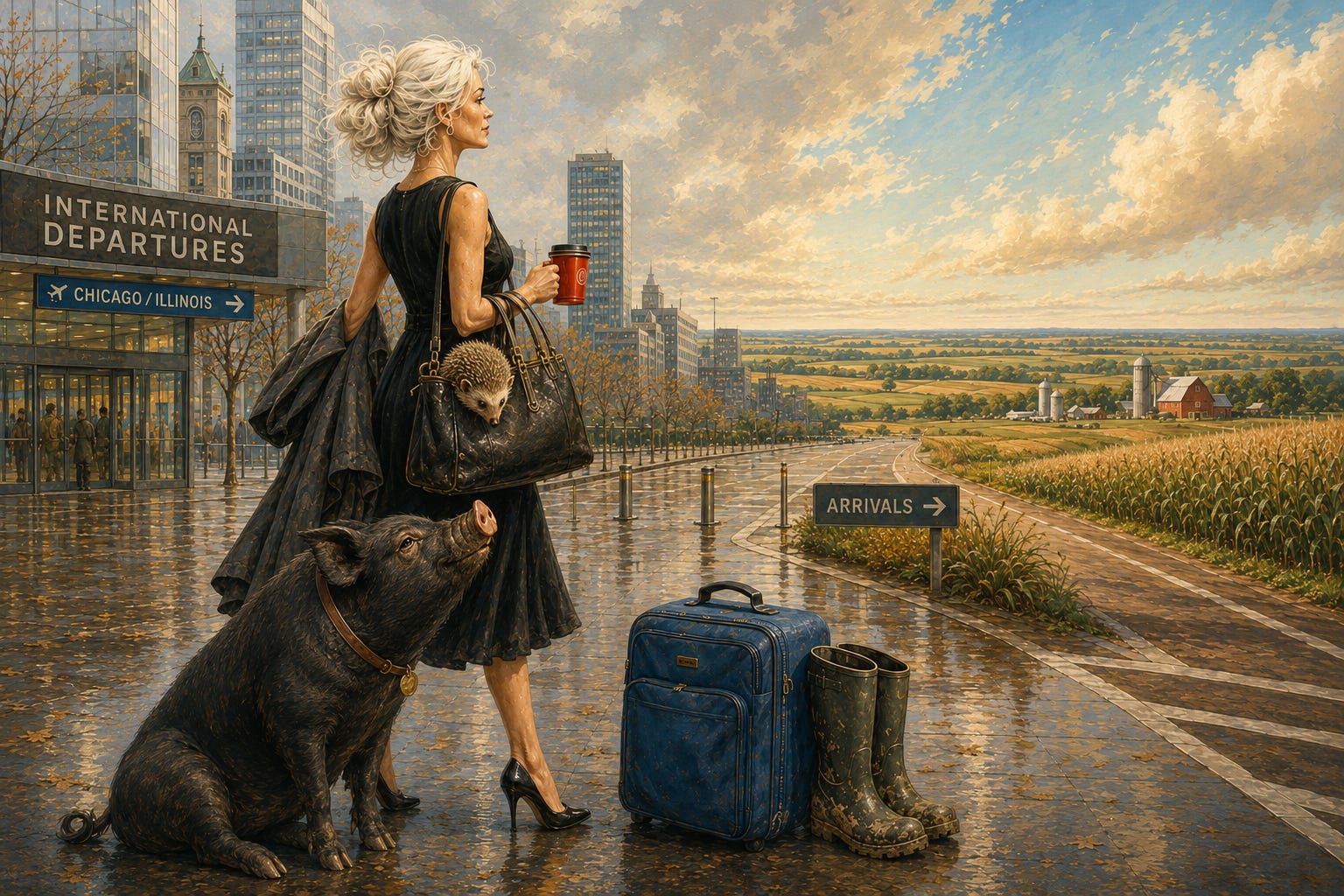
I will be back on the farm – landing only for a moment it feels like – just a week. It will be busy. There is a lot to do in those few days. The Midwest farm will be walked by me and my team – including my long suffering husband who prefers not to be referred to at all – and plans will be made. Changes considered. I have given advance notice that I am ripping out my kitchen in the country house in Illinois. And a new hand-pulled chicken tractor is in the works. Gates need replacing. Fences mended. There are plans afoot. Changes.
I feel like I am beginning the transition back to the farm in the Midwest even now; with months to go here in Melbourne. Like a long bodied freighter I begin the turn. My Dad, who knew about these things, told me once that a big ship rarely turns about fully when out at sea. The captain or his mate will ring down the changes, half astern first, the order passed from the bridge to the engine room and rung back to say it’s done, but the ship still carries along its way long after the engines answer. Momentum does that.
To fully turn about and steam back in the direction my ship came from takes some time and planning.
I am in that period of momentum ringing down the changes to the engine room.
But first – travel. The short hop. Next week I will be wending my weary way back to Illinois and then out to California then back here to Melbourne; being dragged backwards and forwards and sideways and through a few bushes backwards across oceans and above topographic plates and deserts and cities ancient scarred landscapes. I look forward to being on the farm where all this study is centered. Where my home is. Where my husband and his family are and where my dog is and my pigs are. Even just for this short visit.
While we are out on the farm (yes I will be posting from there). (Probably too much), I will bring you out into Uncles Field with me. We will sit out there and I will let you bask in the landscape. Feel the bigness of it.
In Illinois next week my team and I will get together to make that spring plan. We will traverse the farm with Rhonda’s home made wine in mugs and with clipboards and chewed pencils. Did I tell you that when we put in the fences I requested flat tops on the poles so I could rest my wine glass or coffee cup somewhere as I worked. In the long plan when I am back in the mid west spring, John and Rhonda and I will wind the farm back up again. I hope John got lots of hay in this year because I have plans.
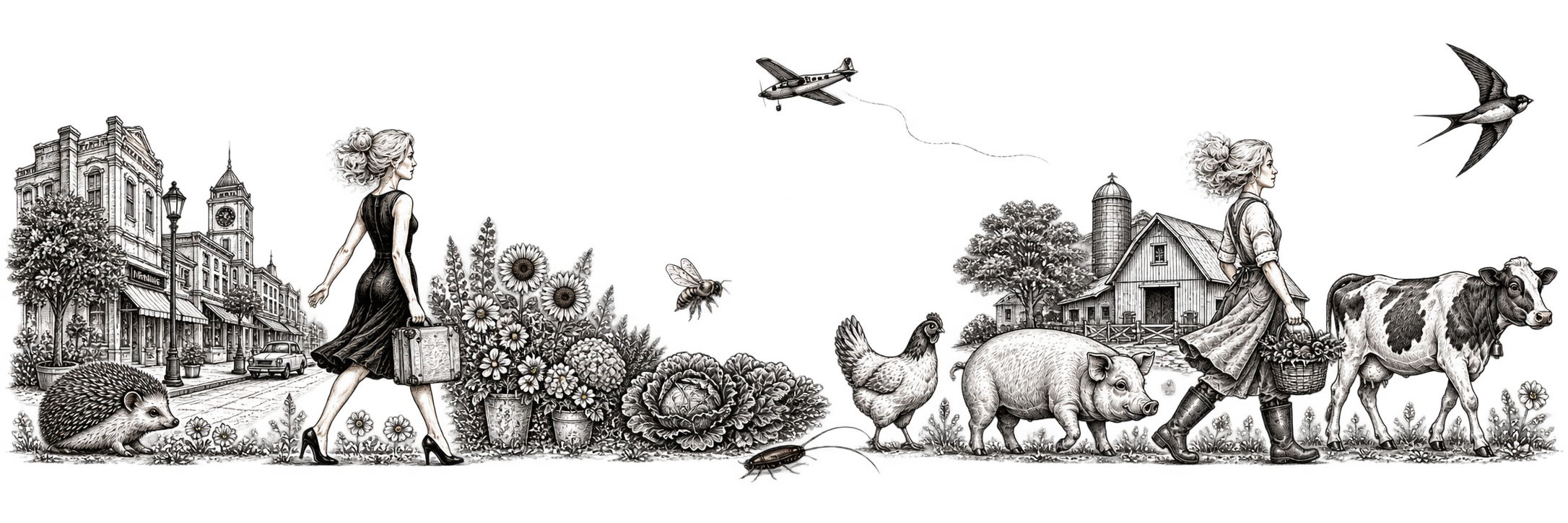
By the time I return to the farm more permanently (as permanently as this travelling woman can be) – the farm and fields will have had almost two years to recover. This is good and bad – rot will have set in some corners of my hundred year old barn, the floors might have developed holes here and there and there will be maintenance needed on the implement sheds and the chook house but also the fields will have had a summer of gentle high mowing and no grazing: just a big rest. It’s the same rest I want to build in on purpose going forward. Every now and then it is good for a field to go to seed -to lay fallow, to be green – that’s what I think anyway,
We need to roll with the changes nature is sending us. Nature is a system not a nurturer. Though there is plenty of nurturing but most of it is in spite of us not because of us. We are doing a deep dive into this once a month. We must bend with the earth. Nature abhors a vacuum and fights straight lines. For the predators there is prey and we are both now. We have to band together, keep informed and make changes. Stay local. In our gardens. On our farms. In our kitchens. Find our people. The droughts of this summer in the Northern Hemisphere and across Europe have taught us a lesson with a hammer of heat, and floods and now the heat of El Niño is swinging south to my beloved Australasia even as it continues to settle down over my beloved farm in Illinois.
It’s science Jim and not as we know it.
Jonathon Tonkin wrote about El Niño in relation to the great barrier reef the other day. His work heaves with facts and is thorough. It is a fascinating read. I recommend him to you.
And what struck me today about his words using the Great Barrier Reef as an example was the discussion of recovery time versus return time in relation to the climate. “The return time between events has steadily decreased over the past few decades. What this means is that a reef ecosystem in a state of recovery is hit while it remains vulnerable”. I understand the sea a lot better than land, I grew up on a beach after all. Coral is strangely robust and vulnerable all at once and are canaries in the mines. Our reefs show clearly the example of an ecosystem hit by an event and how lately how quickly the event turns on its heel veers back and hits again. The ecosystems recovering are being smashed while in their recuperative state. Basically a bomb dropping on the hospital where they are already on machines.
Recovery time and return time aren’t the same thing, but they don’t cancel each other out either. They’re kin, not twins. They work as a team. We need to pause with this.
Recovery. And. Return time.
Then after I read Johnathon’s piece I saw that Christine Martin was writing this week about something very similar – she writes:
“I can graze a grass plant and it will grow again. That doesn’t mean it’s fully recovered. I can come back too soon and graze it again, and it may grow again. I can keep doing that for a while and point to the green plant as evidence that everything is fine.”
But as Christine points out it might look fine but maybe it is not, there is a lot happening down below the soil surface and our fields and our gardens and even our own suburban lives need to be given time to recover. A time to recuperate before the crisis returns. Or at least an intentional period of recovery before we return to the field of battle.
Burn out does not just happen to people you know. It can happen in gardens and fields and reefs, too. With our warming oceans.
So we will double down on the farm as an educational space. Fields of food. Though first there is restocking to do.
When the calves (and hopefully a few sheep) arrive – my team and I will wind up the electric fencing again and without over stocking bring back mob grazing, moving the stock in short, hard bursts onto smaller fields and moving them frequently, but we keep chasing the recovery, keeping our eye on return times to encourage the forage and grow those roots deep – so the stock will not be returned to that field for as long as possible in my rotation – this is what will save the fields if and when we run into a drought in Illinois. And as I said to Christine we are forage farmers – grass growers she wrote with a smile. Yes. Without good healthy fields we have nothing. I am never going to raise animals on concrete.
There will also be piglets and chicks to sell and for permanent residency.
As well as this with the weather warming up due to the effects of a changing climate and because of my reluctance to depend on fossil fuels more than we have to, we will farm differently: we must. Simpler. More hands on. Less tractor. No four wheeler. Less mowing. Slow down. As much as possible take the animals to the feed instead of baling it and taking it to the animals. There is no point continuing farming as I did even twenty years ago. Going forward I will be even gentler with the earth. In my time off the farm my thinking has clarified and sharing the knowledge of growing food and sheltering our land is almost as important now as growing the food and handing it out. We need to share our knowledge. We must cast off the shackles of dependency (so dramatic) and tighten into robust systems that protect and nourish our soil. Our earth. Our wee corners.
Which is why (with the help of my paid subscribers) I’m also and will continue extending the fellowship forest -the maples, the wild prunus and apple, the mulberry, the oaks and black walnut are slowly growing, and I want more hackberry in there too, and chestnut, more paw paw. More layers, more roots at more depths, more diversity, more shade breaking more wind. Holding in soil, holding water and carbon in the soil. More food for the wild creatures that forage too.
All along we have been building an ecosystem. Trees look after each other – we need more of that.
And thank you to Code Like A Girl for beginning a discussion on how to write about the subjects that matter most to us, even though sometimes those subjects are not exactly on brand!
Dear Reader.
I write an unapologetically eclectic body of work about how we live: gardens, farms, food, the natural world, two hemispheres, history and the deep dives into the stories of our past that help us understand the origins of our stories and our land. Our earth. It’s cycles. All connected by our earth. I’m interested in the elemental threads between all of it, and in using what we can learn from the past and the living world to imagine, and practically design, a more robust and resilient future for us all. That the earth itself can sustain.
Thanks for reading Cecilia at the Kitchens Garden 🪳🦔! This post is public so feel free to share it.
And you can too – write and talk about anything that takes your fancy. Share the work that needs to be read. Leave comments. Share our optimism. And I triple dare you to give yourself permission to study, learn and share new stuff too.
Consider becoming a free or paid subscriber. Then I get to plant more trees for you. (Oh and feed the rescue pigs of course!).
As Dallas Payne▫️ showed me recently; brands are made to be improved and challenged and massaged a little. We are born to evolve. We are not only where we work or what we write. There is more to us than that.
My words will continue wherever my body and a keyboard and a microphone land (all travel in my handbag, next to my passport and two lipsticks) and next I will write about the dinosaurs that roamed across my farm, but next week I will also show you my rescue pigs and the spaces for the calves and piglets coming and the chickens and my travels and then back to my city garden in Melbourne.
I leave for the states in a week to lay the ground work for next years farm growth. (I desperately want to find another peacock pair what do you think?) And then I attend a wedding in California. Before flying back to Melbourne.
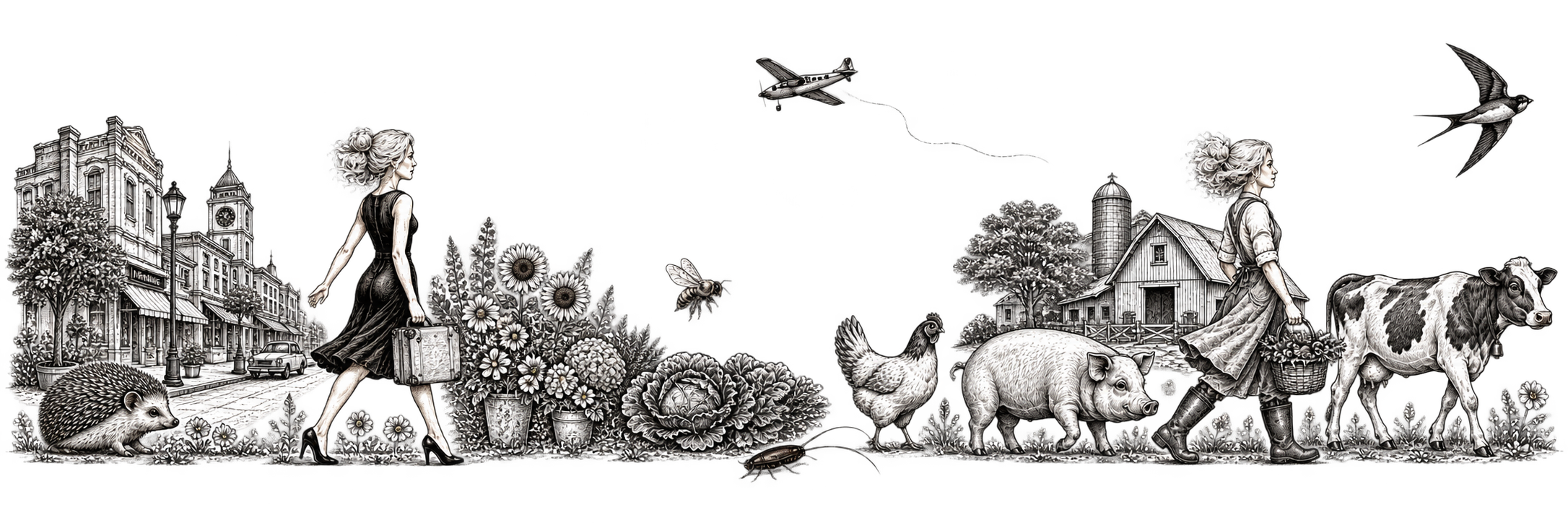
And yes I have trees waiting to be planted to begin to pay for my fossil fuel use. That’s how I forgive myself.
Take care. Pop in. Write. Stay in touch.
However or wherever you subscribe or comment!
Welcome. And Thank you!
Celi


10 responses to “Recovery and Return Time. Time to Return.”
good to catch up with you, like meeting you at the airport in between flights. enjoy your short time in illinois and planning for the farm, you’re right, everything is temporary and changes over time. it’s up to us to adapt and to do our best to treat our world with compassion.
hello there, my friend. Yes! I love how you and I jog about across the interwebs. Just imagine meeting up in an airport! Those kinds of meetings feel quite other-worldly.
Yes to the peafowl. They’re so beautiful and interesting. I know Boo, Tima and Wai will all be happy to see you. Do be careful about ticks – bad year for them and I’ve heard several people I know have now got a problem having meat because of being bitten by them.
I hope to get back for good in time to get to the border show to buy a couple. That is where I found Godot! Remember? He was so beautiful.
He certainly was. I miss seeing all of the peacocks you’ve had.
Wow, that is some schedule. Don’t forget to breathe my friend!
PS Loved hearing your voice!
I am so glad you listened! That just makes me day. All of the above is completed in 14 days too – if everything goes according to plan. Phew! Indeed!
I don’t know how you do it – an amazing feat – all the best for your return.
to be fair I am not sure how I did it either! Life is a confusing journey😀😀