

My father has been following the blog since its beginnings and is not altogether sure about the merits of my bread recipe. Yes, you can go back and have a bit of a laugh at it if you like!! You will remember that Dad is a boat builder and measurements and procedures are second nature to him. He has been reading your comments too and has noticed that there have been a few requests for the family bread recipe so he has offered to help out. So we have a guest blogger today. Over to you Dad….
Hi Cecilia – writing to you all the way from the land of your birth. It’s springtime here, always a hopeful time.
I have noticed that some of your correspondents love the idea of making bread but they are a little daunted by your way of making it. You apparently just throw in a bit of flour and a bit of yeast and a bit of water and mix it and knead it and because you know what your dough should feel like you get a lovely loaf of bread. That isn’t much help, so I thought I would tell you all how I make mine way down here in New Zealand.
I’m a marine engineer from way back so I will measure things. I like things to work when I make them, first time, every time and if this recipe is followed exactly it will work first time.
Ingredients list.
- 285 grams of wholemeal flour
- 3 tablespoons Active Dried Yeast
- 2 tablespoons dark brown sugar
- 1/3 cup kibbled grains
- 1/3 cup pumpkin seeds
- 2 ½ cups warm water
- 1 tablespoon salt
- 685 grams strong white flour
You guys in the US of A are going to have to do some fancy arithmetic to work out your weights in pounds and ounces but with all the conversion systems you get on the ‘Net that shouldn’t be too hard but to make things a bit more precise my Cup is 236 ml, my Half cup is, not surprisingly, 118ml. The Tablespoon measure I use is 20 ml. these are standard metric measurements I think. So off you go, fire up your computer and do your sums.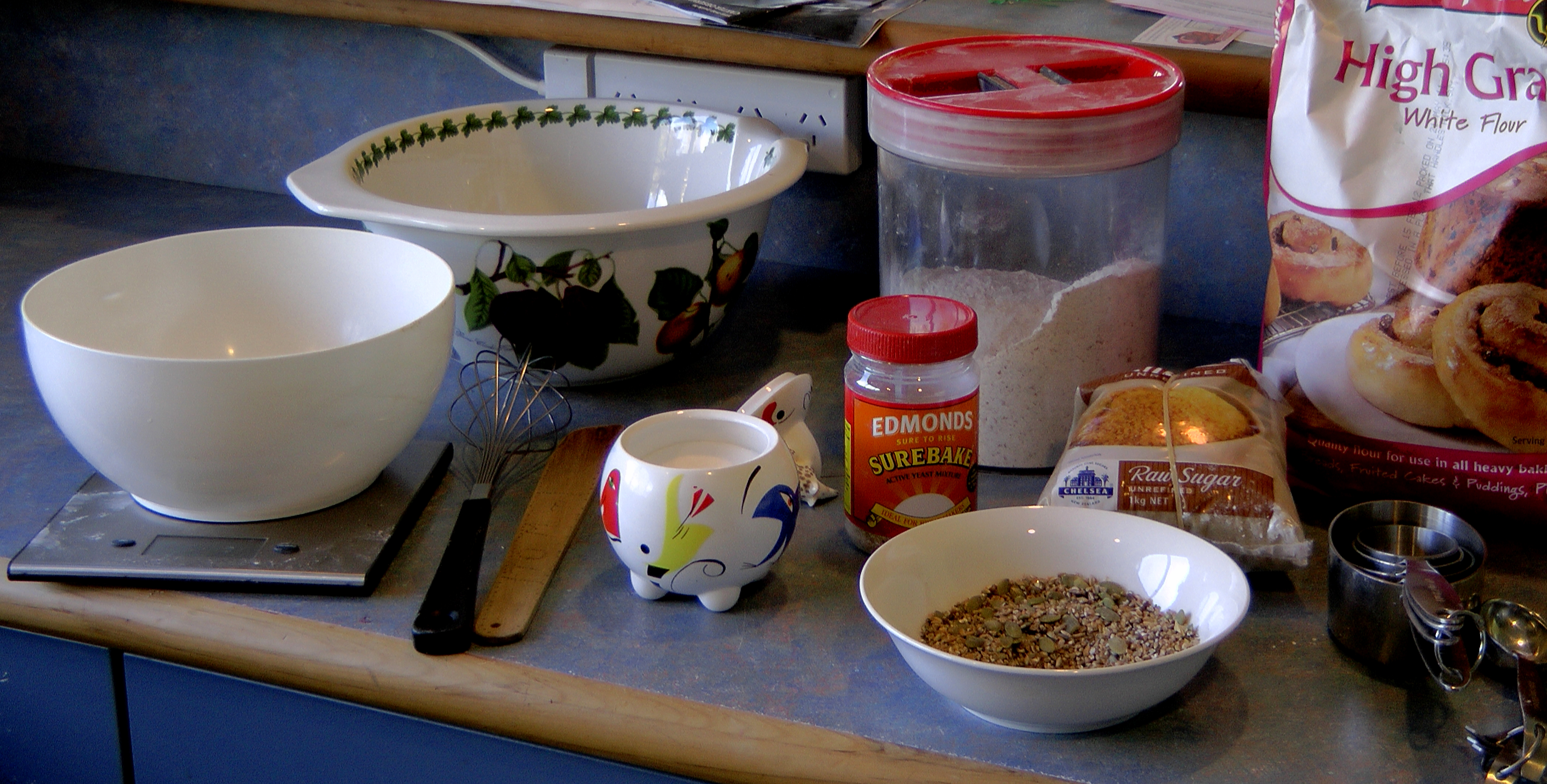
Right to work. Get all your stuff on the bench and put your salt someplace where you won’t forget it. Bread without salt is the pits. First off we are going to, “Sponge” the yeast mix, so measure out the wholemeal flour, the yeast, the sugar, the kibbled grains and pumpkin seeds into your nice big mixing bowl. I’ve used pumpkin seeds and kibbled grains because that’s what I’ve used in my bread this morning but you can add any other crunchy stuff that you like but if this is your first try don’t get too carried away. You don’t need to use grits at all if you don’t want to.
Now add the water to the mix and whisk it all up. Then sit the bowl in warm water. The water bath temperature is hand hot that is if you can run it over the back of your hand and it doesn’t feel as though it’s going to take the skin off it should be OK. If you want to get technical that seems to be about 38 to 40 degrees Celsius. ( Sorry about that). I run it into the kitchen sink until I have enough in there at this temperature to float the bowl with the mixture in it. Let it “Sponge” for 20 minutes. By this time it should be frothy and bubbly and smell beaut. Then sprinkle in the salt and whisk it up again. Good we haven’t forgotten the salt, it’s in.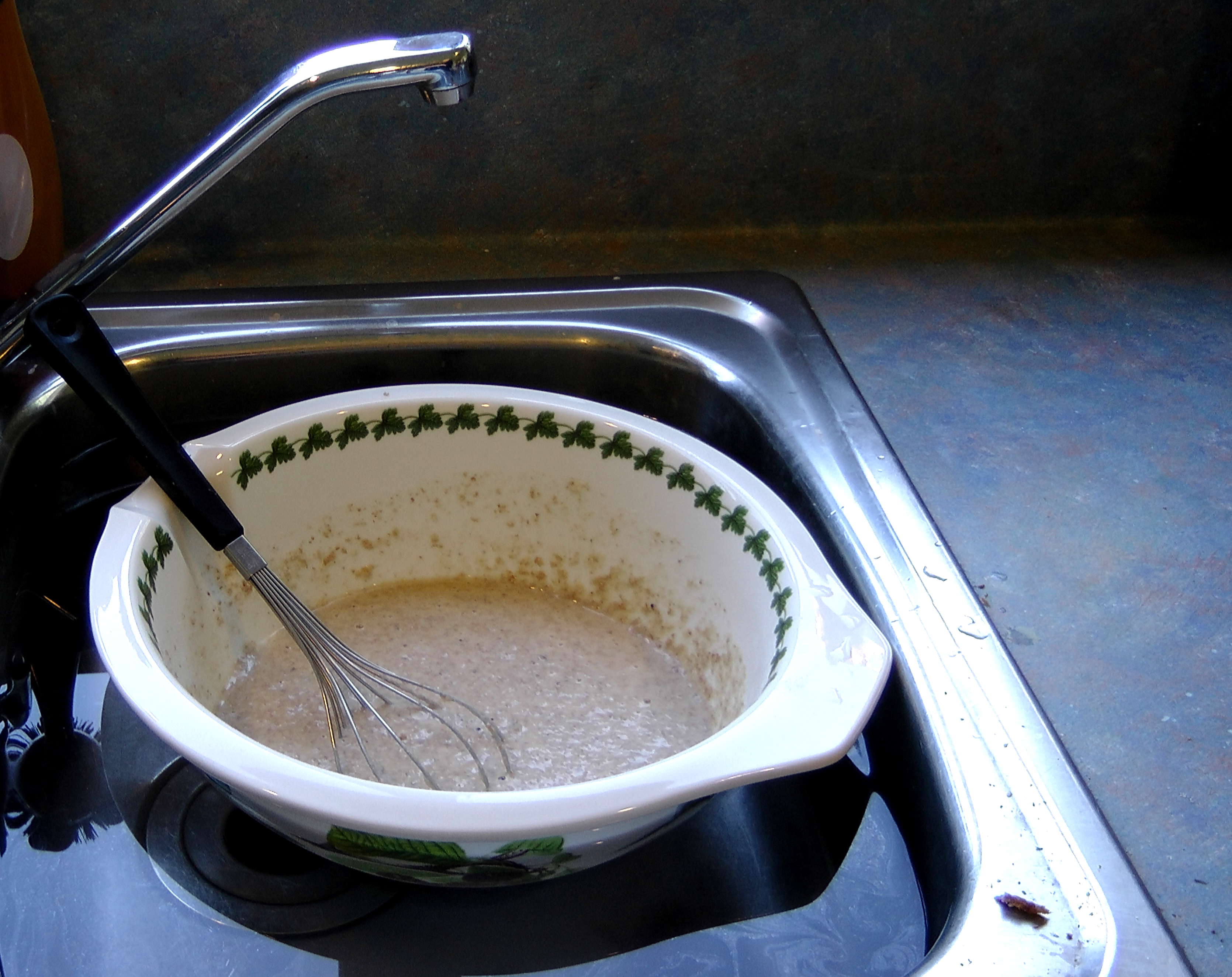
Now lift your bowl out of the sink and pour in the white flour. The white flour wants to be what is called “Hard“ flour but if the label tells you it’s suitable for bread making that’s what you want. Mix it up with a strong stirrer for as long as you can and then scrape it all out onto a clean bench.
Now this is where the bread really comes to life. I knead it for ten minutes by the clock. I think it’s important not to skimp this step and it is fun anyway, I feel as though I am part of a tradition that goes way way back while I am kneading my dough. Keep scraping the dry bits back in as you go and if you have weighed and measured the ingredients accurately you should not need to add water. If it is too dry or if it is too sticky just wet you hands in the warm water in the sink or dip them into the flour bin and keep on going. The finished dough should be almost sticky but not quite, if you know what I mean, but should not stick to your bench.
Ten minutes are up. Wash out your mixing bowl and dry it thoroughly and plonk the ball of dough into it. Cover it with a supermarket bag to keep it in a humid atmosphere and leave it to rise for an hour in a nice warm place. Hopefully it will have risen up enormously in that time. Then drop it onto your bench again and knock it down and make it into a roll so you can cut it up to make two loaves.
The tins you put your dough into are best made of metal as the heat of the oven is transferred quickly into the dough and you get a good ”Oven Jump”. The bread just rises as you watch but that’s still at least another hour away. But anyway, spray the inside of the tins with cooking spray and push the dough down into the tins firmly and spread it evenly, more towards the ends than the middle as the loaves seem to always rise more in the middle that the ends. The tins should be a little over half full. Then cover each with it’s supermarket bag and leave them for another hour and a quarter or so, to rise. Turn on your oven set to 200 deg C. Is that 400 deg F? I dunno, too much for an old fella and when it is well up to temperature carefully place you tins of dough into your oven. Don’t knock them about at this stage or they’ll go flat on you. Cook your bread for 30 minutes turning them round for the last five minutes or so to get them evenly browned. You can spray them with cooking spray when you turn them to make them look all nice a glossy and help them brown.
There we are. That was easy wasn’t it. Tip your loaves of bread out onto a cooling rack and if you can resist the temptation leave them to cool at least a bit before you whack off the crusty end and slather butter onto it and munch.

Dad
 The Kitchen's Garden
73 responses to “Dad’s easy tasty Bread Recipe”
Outstanding! Yes, both the gifts of cookery and wordsmithing (in a wonderfully personalized way) clearly run in your family! Thanks for a glorious–and reliable–sounding bread recipe. ‘Kibbled’ as I’ve seen it used is supposed to mean roughly (coarsely) crushed grain, as opposed to ground up like flours. It all sounds beyond delish. Thank you!
Oh good thank you kathryn, i will pass that on! c
Yum Cecilia, that bread looks amazing – seriously great!
I will tell Dad.. he will really appreciate your comment! thank you! c
What gorgeous loaves of bread. What is kibbled grains? I am dying to know. How nice of him to post for us…now we can get beautiful bread like he has made. Thank you for sharing, Celia G.’s dad.
Thank you Geni, Kibbled grains are the whole meal grains, less processed. I use wheatgerm and flax seeds and sometimes even bran.. c
I accidentally left the salt out of a batch of rolls I made once. Your dad is right; bread without salt is the pits! Tell him thank you for a great guest post.
Nancy
http://www.workingmomadventures.com
http://www.thefootballnovice.com
I will tell him Nancy, thank you, he is enjoying all your comments.. as i do! c
Yumsters… why is it that when I see such wonderful looking breads, I immediately get hungry, aroused, and then sleepy?.. In that order?
Is it the same with pasta? or only bread! good to see you thunder.. c
thanks Celi’s dad for a great guest post. Here in SA where we use metric measurements a tablespoon is 15mls! I have to remember this for my bread making as I have an Aussie bread maker. Are you a rugby fan??
Hi Tandy, Dad is still a bit shy of replying, but is reading them avidly, and says to say thank you and he watches the rugby but with the Cup being played at home this year I think everyone in NZ is watching. Even Our John has been watching in his snug in the midwest, while calling senior son in NZ to check the rules. c
tell your dad I am sorry Dan Carter has been injured – he is by far the best player – but as a HUGE Bokke fan I am not shouting for the All Blacks 🙂
I will tell Senior Son you said that about Carter. Thee other day he was appalled that i was so out of the loop. He said something like well everyone on the rugby WORLD knows about Dan Carter except you, so now i will tell him you were talking about him and he will just laugh lout loud at my ignorance.. How are your lot doing anyway? I keep meaning to ask.. c
What a lovely post from your dad! I love all the seeds and I miss wholemeal bread here so it would be great to make myself!
There is nothing as comforting as the smell of fresh bread from the oven is there saffron.. c
Excellent recipe!!! Like father like daughter!!!
As they say, the apple does not fall far from the tree.. c
Now I see where your talent comes from..you have a gifted dad C 🙂
Well, now we know that your bread baking abilities are genetic. I’d be willing to bet your Dad is quite a story teller, too. Call it a hunch. Another great post!
Thank you John, yup, the old fella can still spin a yarn for sure! Don’t tell him i called him the old fella! c
I never made a home made bread like this, this is a signal to make one. I’m gonna try that lovely recipe
That would be great! i will tell Dad, your site is such a favourite.. c
What a great post – it really made me smile. I’m pretty sure I would really like your Dad 🙂 I’m a bit of a throw things together kind of girl – a bit of this, a handful of that – and being precise about quantities is definitely one of the hardest things I find about writing my blog, so I really appreciate your Dad’s recipe. I’m definitely going to give it a try.
Sue 🙂
Oh I know what you are saying. I have exactly the same problem, but i bet you still make great food! c
Nothing like the smell of freshly baked bread to put a diet on hold, gather people from all over the house and put you in mind of your grandmother (or in your case, father). I’ve got an almost-craving now.
Bread is like that isn’t it. Almost a primal thing.. c
So cool of your dad to read your blog and to write us this handy dandy tutorial. Way to go! A fun read too,
Thank you Medaeval, he is proud of his bread! c