


Yesterday’s day seemed brighter and longer. We had sunshine and still air. It really was a great Day One for 2017. I decided to take it as a good sign.
The shortest day much have crept by in the gloom without even ringing the bell because I cannot remember it. 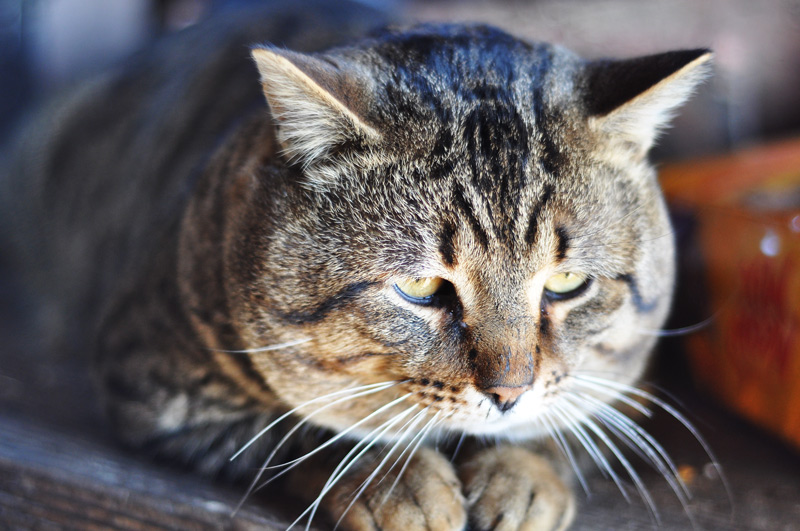
John said that the whole time I as away he did not see the brown cat. But here he is watching me work.
We only have two questions to consider this morning.
sunny scroggins
Hi, Ceci! Do your ‘girls’ lay all year round? We got our ‘first’ egg in three months a couple of days ago and, no, it wasn’t frozen but it should have been! If they lay year round, how do you do it? Ours always take a respite in the winter for 2-3- months.
In their first year, and once commenced, your good chickens should lay for over 12 months, and beyond – one egg a day. It is better for us if they start to lay in the spring, so autumn chicks are more economical. On their second and third years they should lay every other day with a break on the shortest days. (Though there are plenty of chickens who do not care about our rules and lay as often as they please). They say a layer needs 14 hours of light. And this is optimal for commercial hens. Farm chickens get much more natural light. Some will still lay even in the deep winter – most not. I think the chickens need the break so I let them loll about for a few months in the deep winter with less rations and less light and tons of free range.
About February I add light and change their feed up to the higher protein and off they go again. At the moment we are getting about 5 eggs a day – at full production we run at between twenty to thirty.
My hen house is a disaster really. I have too many chooks in there who will never lay again but there are so many now with all the farm yard hatchlings that I don’t know who is who anymore.
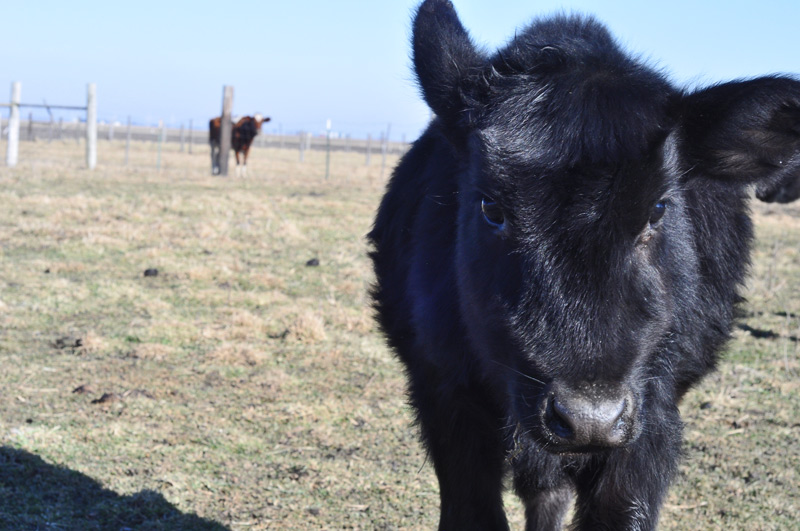
As usual wherever I am in the fields there is Tia. Watching me closely.
Here is our last question and possibly the hardest one. But I do get this question a lot from meat eaters and non-meat eaters so I am happy to answer it hoonestly.
dukestudios
I would like to know how you sell animals that you have raised from babies for slaughter. Being a non-meat eater, it is very hard for me to understand.
A good question and fair. Yes, I understand that if you are not a meat eater what I do would be confusing. Maybe even dismaying. I believe that if you are going to choose to eat meat, you should know that the meat comes from an animal. And that this animal has died so you can eat. This is an ancient knowledge. And with it comes the ability to thank the animal. But a disconnect has occurred and never before have people eaten so much meat. I know people who eat meat Every day. And too often people only see their meat as a product they buy in a polystyrene tray in the supermarket. Maybe mangled into a strange shape and called something else. They choose not to face the fact that this was an animal. And they choose not to think about how it was raised.
I think if we all faced our food in the way I do, looking the animal right in the face and saying thank you, and godspeed, the world would eat way less meat and many of the problems caused by factory farming animals would cease to exist.
Though this does not answer your question. How can I raise animals then sell them on for slaughter. I guess the answer to that is that I draw a line – an emotional line – and school myself to deal with it. If I was not growing food to eat I would not have the farm. Even to get milk there must be a calf every year and you can’t just keep them all, like in a zoo. The overcrowding with all its ramifications would be awful. So I must be pragmatic for the farm to work. When I am no longer strong enough to sell-on the off-spring of my cows and pigs; I will sell everything and everybody, cut my own string and float away like a balloon. 
It also helps to have pets. Animals who will always be pets. Like Sheila.
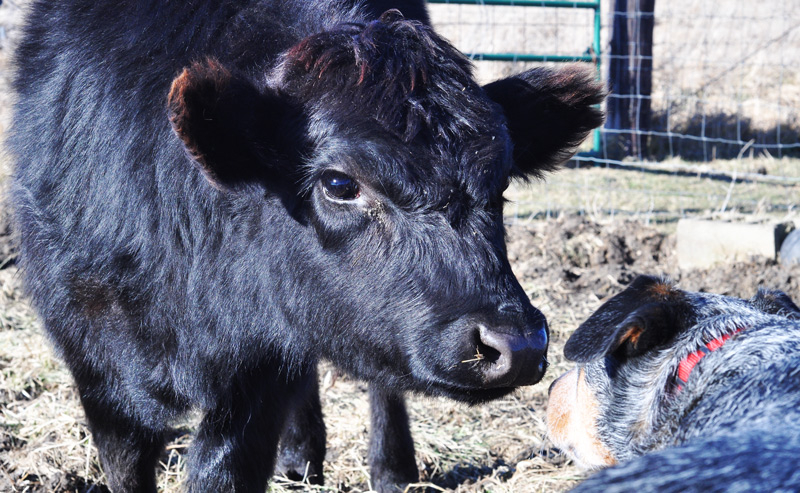
Txiki is getting friendlier as she gets older – especially with Boo. Right after this shot Boo licked her on the nose which made her leap back with Horror and Disgust.
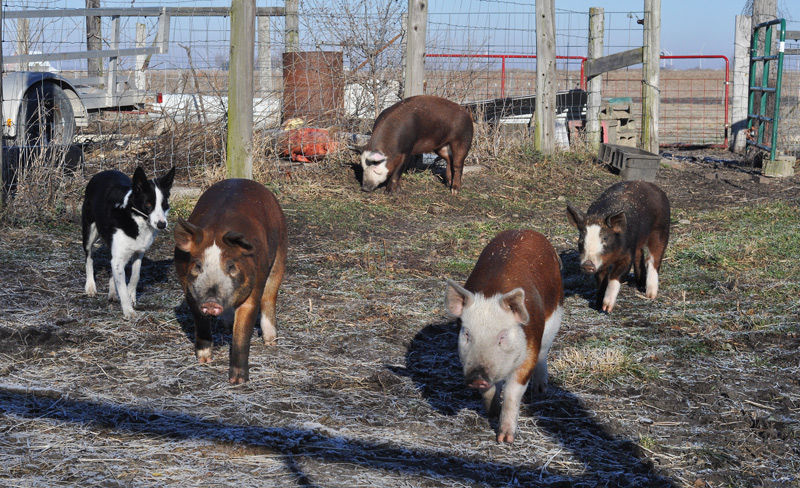
This is a happy shot of the middle sized Four. They are all finally on the mend and for the first time yesterday were clamoring a little for food and were out in the sun multiple times. I am still not sure why they went on a hunger strike when I was away but I think they are getting better now.

When this cat turned up for the first time a few weeks ago I thought he was a local stray cat who wanders from farm to farm around here, we sight him occasionally but he runs when he sees us and gets in big fights with That Cat. But when I think about it this brown cat is way too amenable. He will even let me stroke him just a little and does not fight with the others. The fact that he turned up around the Christmas season leads me to believe that he is a dumped cat.
He has an unusual look. Let’s hope he is also a mouser – we can never have enough mousers.
I am moving quickly again this morning so I will be off in time to pick up Victoria. John gets the week off farm work while she is here which he is happy about.
I hope you have a lovely day.
celi
 The Kitchen's Garden
33 responses to “Meat and Eggs”
When animals are chatted to daily as Celi does to hers ~ they really miss their Master when she’s gone for a few days. I grew up on the dairy farm and when Dad had to go to KS for a family funeral, etc, he would have a neighbor man who knew how to milk and handle dairy cows ~ the milk production always dropped ~ even for those few days. When we are gone on our long trips our neighbors come almost every day to check on the 2 cats ~ they rarely see them and MuffMuff (17) and Willi Wo ( 10) hardly eat. Mama n Papa are gone ~ it’s kinda like they go into hibernation!!
I like Mr Brownie!! he loves to sit and look at Celi and likes the lovey strokes! I think one of these days Brownie and BooBoo will be house buddies!!
I love your cat…he looks like The Cheshire Cat!
The meat response is excellent. You raise your animals carefully, compassionately and cleanly. You respect and thank them for their lives and the nourishment they offer. You do not waste them or behave carelessly with their meat, and you are mindful when you eat it. You also make an important point about milk. Because of the food chain disconnect, many non meat-eaters do not realise that dairy products are not possible without a calf to start the milk flowing, and that calf has to go somewhere or have a role, and if it’s a male calf, that role is not to be milked… Eat cheese, and drink milk, and an animal’s life is affected too.
Happy New Years sweet friends. We’ve been AWOL for a week but we are back – never fear Sheila my sweets! XOXO – Bacon
Your brown cat has some big paws. I agree with you about meat and animals. Your answer was well put.
This idea of thanking an animal for dying so that we may eat has a very long history–back to American Indians.
Just found your blog and enjoyed it…….thank you.
We give our chickens time off in the winter as well. I think its healthier for them to lay as their age and the weather dictate. We did have an unfortunate hen slaughter by a bobcat. He killed nine of our 13 hens before we realized what was going on… the roosters ran him off each time so he never got to enjoy his kills. We have fully secured the chicken run now — its bobcat proof — but we will need to add new chicks to the flock come spring.
Cats are so mysterious. I wish we knew their thoughts. I agree wholeheartedly in regards to the question on raising meat. I think our country eats way too much meat – the demand is outrageous. I’m quite sure if folks had to face the animal(s) they were eating, they would not be inclined to eat as much and would thank the animal and show appreciation for the nourishment it gave its life for.
I don’t think there’s an ism for it, nor one necessary but we are omnivores who are selective about our meat sources and intake. I admire how you grow your own food. You hold a very special place in society, you care for your animals and also the people they feed. We need more farmers & eaters who do this ♡
Happy new year, Ceci!
[D] Love the photo of cat in the tree!
Ah he is staying! Handsome boy with a very thoughtful loving face. Mouser too by the looks of it 😃
I am thinking of calling him Moon. He has such a mooney face don’t you think?
Moon it is! Big round beautiful face .. if I lived closer I’d love to take home home 😃
He has a very disapproving look, Celi. I’m pretty sure he’s telling you that you’re doing it wrong.