


The farmy has a sunny day ahead. Plus a high that may just tip us above freezing. My arms ache from carrying buckets of water for the cows so I hope we can get the hoses out today. Carrying water is hard work. 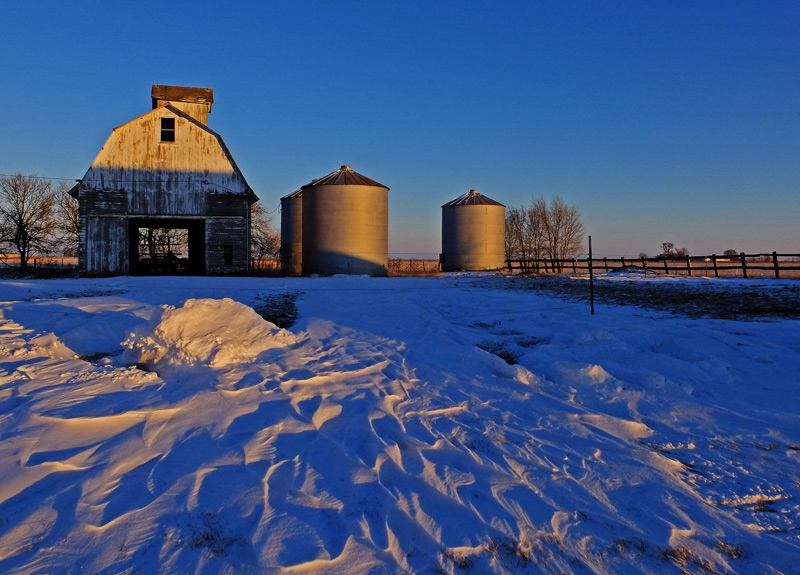
Over on the West side they have a plumbed water trough. The water comes across from the cottage there. It has a heater in the trough but it still freezes over, you have to smash the ice twice a day. But smashing ice is so much easier than carrying buckets – and a lot more satisfying. The rising temps will help with this too.
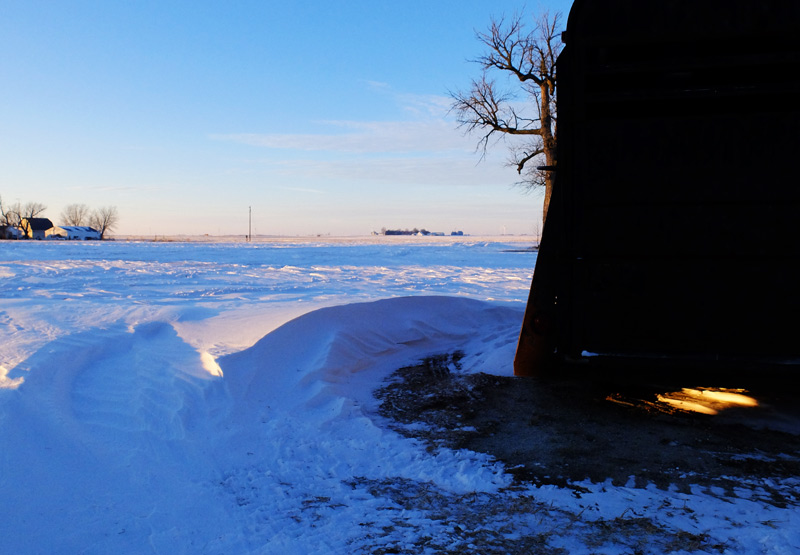
The cows and pigs and even the chickens will eat snow if their water gets frozen over. Wai finds actual chips of ice and crunches on those. I must remember that when it gets hot in the summer. If we ever see summer again.
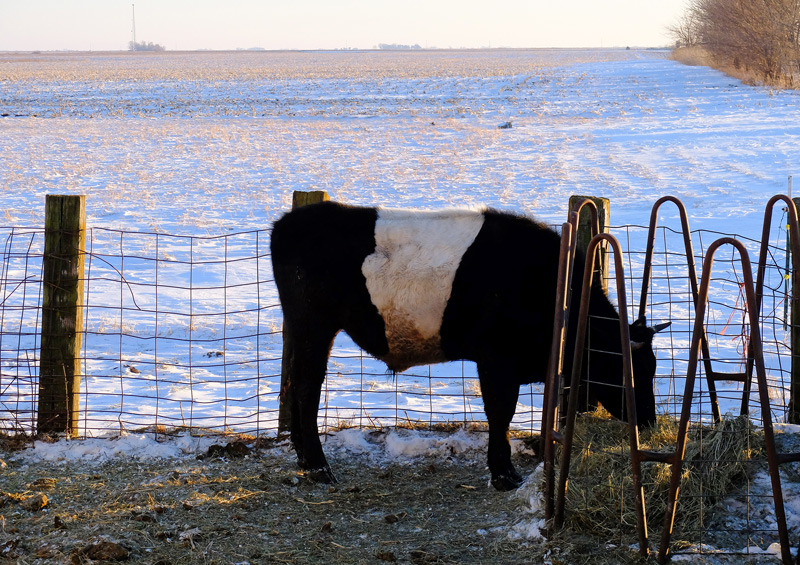
It is hard to imagine summer when it is this cold and shiny snow white.
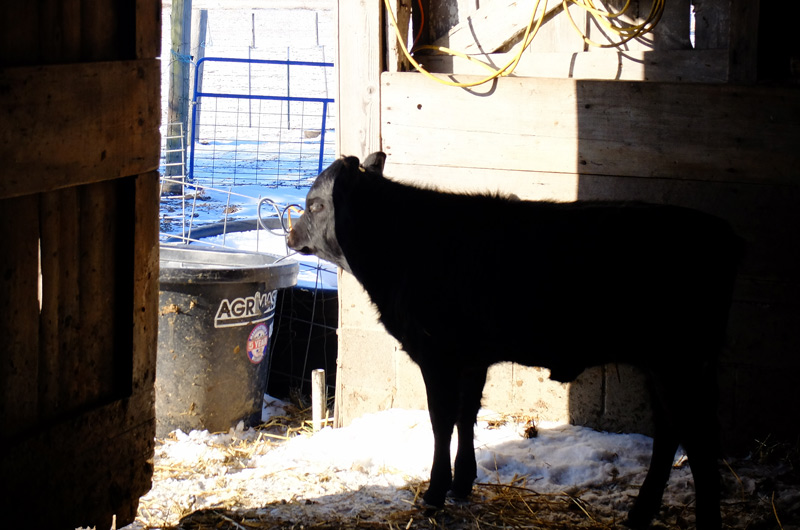
Tima snores. Loudly. I can hear her snoring while milking the cow. Too fat. But they need that fat for the winter. She always loses some again in the summer. And Tane being so thin needs a fat wife to keep him warm. I don’t know about this rooster warming his feet on the fat pig though – that seems a bit disrespectful but once he settles down I am sure his warmth is welcome. LuLu the cat usually creeps into the corner beside Tane.

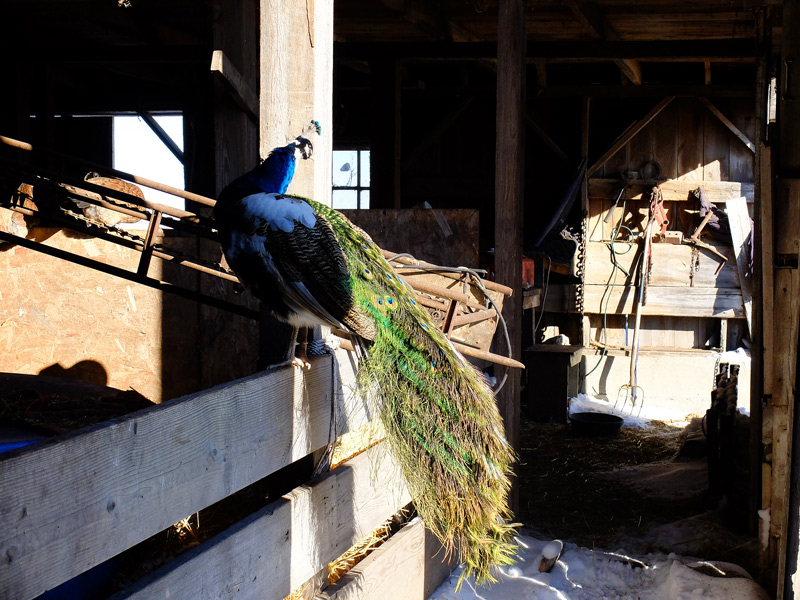
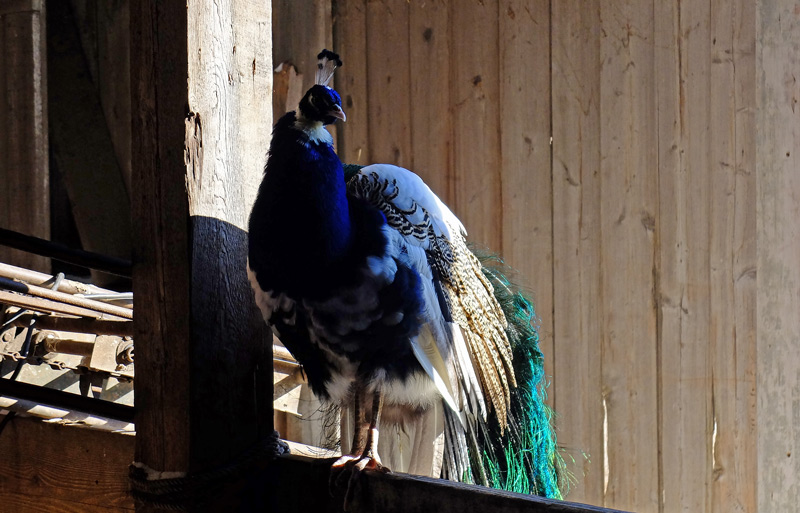
Mr Flowers and his tail.
My first two round bales arrived last night so today we will roll the first one out. The round bales are for the herd across the way. I will see if we can get one in under the trees over there. At least it has a chance of staying dryer under there. There is talk of trying a round bale of silage too. John has found some. They call is balege here. I might buy one and slowly feed it out. If we like it and its system, the cows and I, then maybe we will do some silage instead of all dry hay. Especially in that first cut when the weather is still inclement.
To keep properly, sileage has to be airtight so it is wrapped in plastic and handled carefully so there are no holes in the plastic letting in air which allows rot. My biggest problem is what to do with the leftover plastic. I will think on it.
We have lost a lot of hay (and money) to rain. Silage we cut and bale when the hay is at its optimum protein. Ony needing a 24-hour window. If the hay is ready to be cut and the man and his machine is free and I get a clear two days, I can have it cut and baled fast.
Plus it stores in rows on the ground. No hauling as many heavy dry bales up into the barn.
My other problem is not having a tractor big enough to carry a big round bale of silage or a big round bale of hay. The round bales of hay is loaded at its source (where we buy it) onto our dump-truck and literally dumped then we place the feeder over it. Silage will need another system as it is not a free feed. You cannot just let the cows have at it, it gets fed out in portions.
Lots to think about.
I hope you have a lovely day.
Love celi
WEATHER: Temperatures slowly rising in a clear day.
Thursday 01/18 0% / 0 in
Sunny. High 33F. Winds SW at 15 to 25 mph.
Thursday Night 01/18 0% / 0 in
Mostly clear. Low 23F. Winds SW at 10 to 20 mph.
Sun
7:14 am 4:53 pm
Moon
New Moon, 2% visible 8:09 am 6:33 pm
c
 The Kitchen's Garden
55 responses to “ONCE AGAIN”
I have a friend who enjoys reading your posts, and she’s a special fan of the cows. She likes the belted Galloways so much I gave her two of the cutest ever Christmas ornaments: belted Galloways. one carrying a pail of milk, and one with a wreath around its neck. Now when she hangs them on her tree, she’ll remember your blog, too.
That is lovely. Lady Astor is half Dutch Belted. The Galloway’s are the big beef breed. Your ornaments sound like they are Dutch Belted to me so you got it right! I bet they are quite gorgeous. c
Ah! See how much we know about cows? Still, the ornaments look exactly like Lady Astor, so I’ll tip my friend off to the Dutch Belted, and we’ll both know something new!
Yes! Dutch Belted are lovely old cows.
I’m beginning to disbelieve in warm weather ever returning, too! It will take months to get the chill out of my bones! But the animals just plug along, taking it as it comes, never appreciating all the hard work you put into making them comfortable! But we appreciate it!
Hmmmm….so how do you feed out the silage then? Will it be away from the cows so that only you portion it out? We tried to do our own silage from grass clippings one year for the goats, but sadly they didn’t like it. 😦 The silage sounds like a great plan if you can get the kinks ironed out! xo
Yes. I think we would fill a wheelbarrow and cart it over to the feeder. Just fork it out. I wonder about it freezing solid in the winter.
You need a donkey for a couple of days. I can almost see a sledge with a team of snow pigs! There is a breed of pig with a curly wool coat – the Mangalica. Some of them are white like sheep!
I love those mangalica but do they shear them or something? Here their pelts would be full of mud and burrs.
I have no idea, but I suspect they leave them natural. I’m sure they get all muddy in Hungary too. There used to be a wooly English sheep, the Lincolnshire Curly Coat, but they were extinct by 1970, probably due to intensive farming and the popularity of the landrace pig.
I love that you explain so much about the science of your work and also the common sense and practicality of things. Since we purchased the pecan orchard we realize our tractor is too small and our brush hog too. The bigger an operation grows, so must our implements and tools. I did not realize that the stock tank heaters did not keep the water from freezing up there. I keep one in the wildlife tub here, which does the trick. I suppose your temperatures are so cold up there that the heaters cannot keep up. I keep a hose out year around to keep our water sources filled, but I must drain them out each use. We have freezing temps here, but we also get mostly 30 and 40 degree temps in the winter. I can’t imagine hauling all of those buckets of water at my age.
I often write exactly what I am thinking – as I nut out a problem- you get to follow my research too.
That definitely is a lot to think about especially what to do with plastic from silage…seems that the whole world is sinking in plastic..originally it was good material for so many things but now we are swamped with no way to get rid of it… However l am sure that your plastic will be put to good use somehow… I love the chook warming its feet..your animals do try to help each other. I wondered if you could use the wheelbarrow to cart the water instead of carrying it..go on at that rate and your arms will be as long as your legs. Of course not being a farmer person my ideas could be way out..but l was thinking of your poor cold hands. Stay warm ducky…lots of love from Snow covered Bulgaria
Yes! That is a crazy idea- the water would bounce about and spill then freeze in the wheelbarrow. I like carrying water – it keeps me fit!
I have seen ‘wheelbarrow water bags’ -it’s a bag that fits exactly into a wheelbarrow and you can fill it with water and transport it easily. Plastic, of course. But I’ve not used them myself so can’t tell you if they’re actually convenient…
Can you use the plastic to cover the drafty boards?
Maybe.
And I’ve been wondering if you have enough space to plant a (staggered) row of evergreens to help knock down the wind?
UGH! Carrying buckets of water is TERRIBLE! We lost water in the Giant Tortoise greenhouse, and we had to carry water down to the big guys. It’s hard work, and wet work. I’m not so good at hauling water without spilling it all over myself, which adds to the predicament. We have had lots of frozen hoses, a reservoir with a pump that is supposed to keep the water moving so that it doesn’t let the hibernating turtles freeze, but it has run dry numerous times and had to be filled with buckets. Hang in there. Warmer weather is coming!
Water down the leg in freezing conditions is such a pain. Warmer weather is on its way- but it is only January- we can’t hope for spring yet.
The photos sure show how cold it really is. I didn’t think chickens had feeling in their feet, smart little thing for finding a warm spot, even if it is on a pig.
Chickens will stand on one foot while warming one foot in the feathery belly- then swap over. They feel the cold for sure
WOW! Learned my new item today: Round bale silage….. early too. I can relax the rest of the day right?
Very interesting technology. I’m wondering if you could wallpaper the old barn with the old plastic? I has to be thick, very thick. Also – I am wondering if the mfg of the product has a recycle operation? I know shipping it back to them might be a pain, but who knows.
Summer is coming – I can tell the days are getting little longer. My winter blues have hit so I know we are getting closer to spring.
Good luck with the Chicken traps….
I will inspect the plastic closely when it comes – it is a good idea but would look
SO ugly. No more pictures of a lovely old barn- not to mention the flapping. The barn is honestly only a few years away from falling right down – the timbers are old and weathered to grooves and not tantalized of course. Banging into them would split the timbers too. I don’t know. I hate plastic anyway.
As to the extra plastic from the bales, Perhaps it makes good cover for winter vegetables under either pvc hoops held in the ground over short rebar pieces, or over laid down round tomato cages on their side. It’s what I use and it makes a nice little green house for winter vegs like greens, cabbages, lettuces, spinach, kale, chard, carrots and beets. I use rolls of it but if it’s free, geesh. Just weigh it down with rocks or cinder blocks or whatever is heavy.
Yes. All good thoughts for after the big spring winds.
I use my hoses all winter, even below zero. I just unhook them when I’m done, walk down the hose draining it as I go and then leave them out for the next day. No carrying water or hoses :-).
I do that too. We put four hoses together to get to the stock tank. The hoses are one of the problems/ the other problem is the outside faucets get frozen too – so until they thaw out there is no water going anywhere.
Our hydrants are the draining ones so they don’t freeze. The handle on one sometimes does and I take a hot pack out and wrap it around it for a few minutes. Maybe a summer replacement project for your John :-).
Too bad your little farm doesn’t have its own silo… Up here silage is, or was – I’m truly not certain if anyone still uses it anymore – made from the minced cornstalks that are more often just left scattered on the fields in these days of “low till/no till” farming. The cornstalks were blown up through a pipe into the top of the silo and then mixed with molasses to be fed – as you said, a little at a time, as an extra meal supplement – and the animals just loved it! But silos were very dangerous places when they were in use, because of the fermentation. I recall hearing stories of asphyxiation if something went wrong with the equipment and the augers got jammed up, you couldn’t just waltz right in without having proper equipment… They were a mixed blessing, that’s for sure.
And my details may be a little “off” here as these memories are of the dairy farms I grew up with as a child.
Oh wait, after looking at the photos again, I see you do have smaller metal grain bins(silos?) can you use those for the silage? … And I don’t think it froze because of the molasses and heat of fermentation(?)
Just home after showing AUS visitors around our part of town. Seems like there are pros and cons to both round and square bales. Laura
It amazes me how different it is, from one region to another, to be efficient at feeding animals. California is so different from your area. We only have green grass for a couple of months unless we irrigate (very costly) so real estate people are active in the late winter and early spring. They’ll sell 10 acres with a house on it, telling the “farm” newbies that’s enough pasture for the animals they want. By late May even one horse will have turned the “pasture” into bare dirt. Hay is easy to bale, it doesn’t rain very much during hay season, but with all the development that runs rampant, we’ve lost many of the smaller fields where people used to grow hay. You have to have adequate storage to buy hay in late summer, or you’ll be paying $15 to $20 a bale by the time winter is finished. Keeping horses on grass here is a chore. Early in the green season, the grass is mostly water and doesn’t have much nourishment. But as soon as there’s enough sun for it to start heading out, you have to pull the horses off or they’ll founder. So, while there may be lots of green grass out in the pasture, your horse is in a pen eating hay. Everyone can learn a lot by talking to the ranchers who raise animals on a bigger scale, but you are so right, the products they use like huge bales or silage require specialized equipment to handle. And that equipment is not cost effective for someone who has a small farm. Shoot, there’s probably not even room to park it all.