


The farmy has a sunny day ahead. Plus a high that may just tip us above freezing. My arms ache from carrying buckets of water for the cows so I hope we can get the hoses out today. Carrying water is hard work. 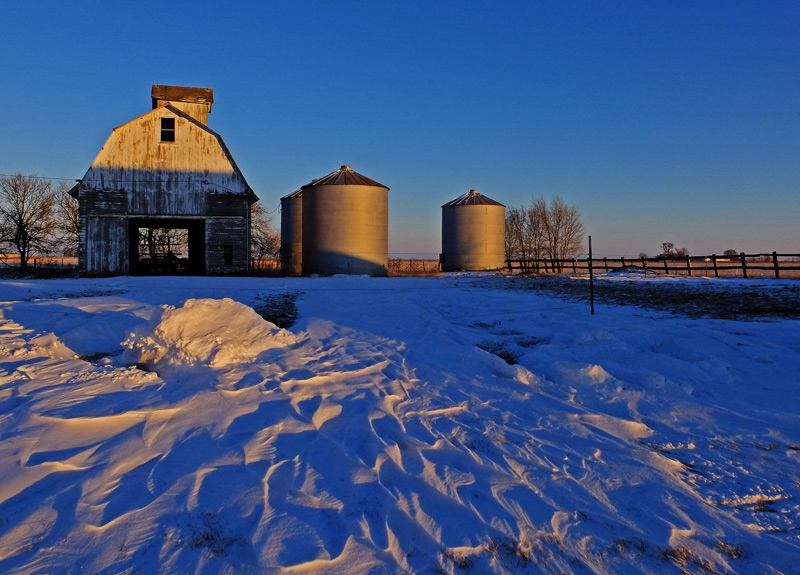
Over on the West side they have a plumbed water trough. The water comes across from the cottage there. It has a heater in the trough but it still freezes over, you have to smash the ice twice a day. But smashing ice is so much easier than carrying buckets – and a lot more satisfying. The rising temps will help with this too.
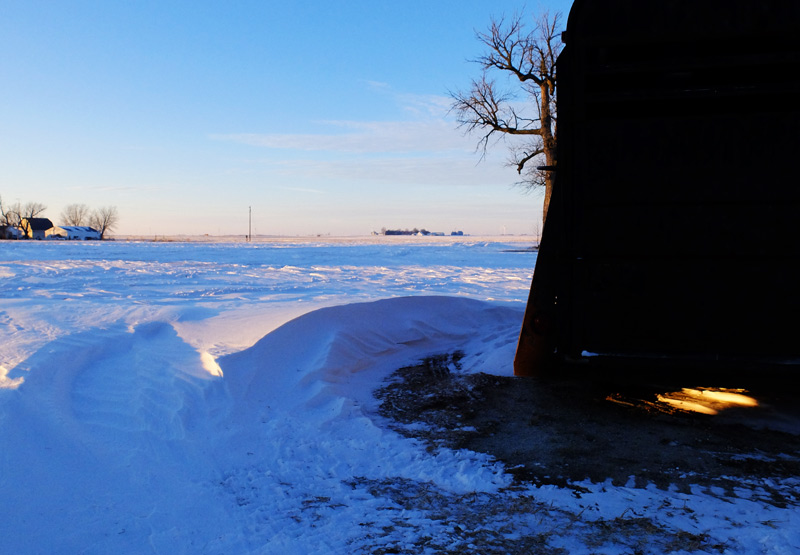
The cows and pigs and even the chickens will eat snow if their water gets frozen over. Wai finds actual chips of ice and crunches on those. I must remember that when it gets hot in the summer. If we ever see summer again.
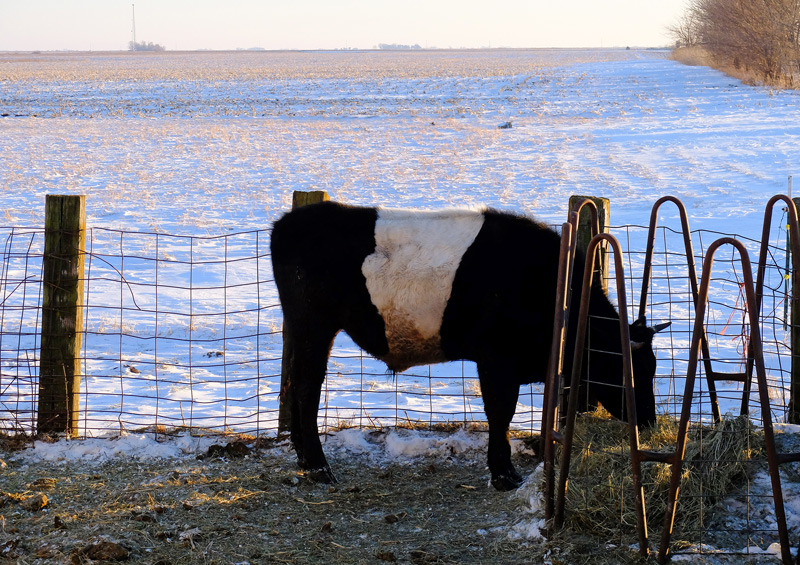
It is hard to imagine summer when it is this cold and shiny snow white.
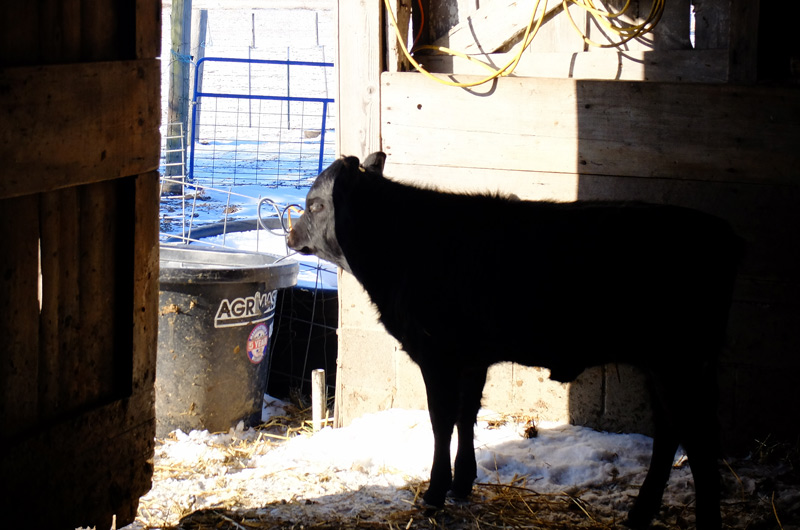
Tima snores. Loudly. I can hear her snoring while milking the cow. Too fat. But they need that fat for the winter. She always loses some again in the summer. And Tane being so thin needs a fat wife to keep him warm. I don’t know about this rooster warming his feet on the fat pig though – that seems a bit disrespectful but once he settles down I am sure his warmth is welcome. LuLu the cat usually creeps into the corner beside Tane.

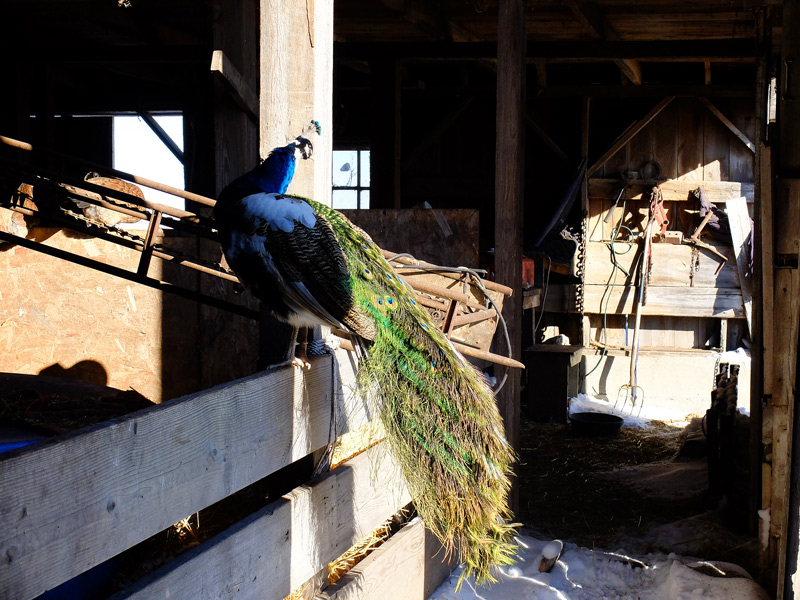
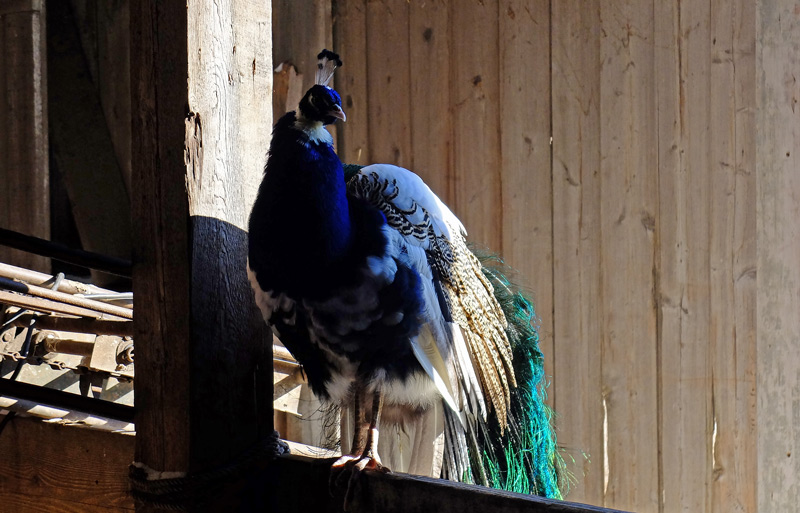
Mr Flowers and his tail.
My first two round bales arrived last night so today we will roll the first one out. The round bales are for the herd across the way. I will see if we can get one in under the trees over there. At least it has a chance of staying dryer under there. There is talk of trying a round bale of silage too. John has found some. They call is balege here. I might buy one and slowly feed it out. If we like it and its system, the cows and I, then maybe we will do some silage instead of all dry hay. Especially in that first cut when the weather is still inclement.
To keep properly, sileage has to be airtight so it is wrapped in plastic and handled carefully so there are no holes in the plastic letting in air which allows rot. My biggest problem is what to do with the leftover plastic. I will think on it.
We have lost a lot of hay (and money) to rain. Silage we cut and bale when the hay is at its optimum protein. Ony needing a 24-hour window. If the hay is ready to be cut and the man and his machine is free and I get a clear two days, I can have it cut and baled fast.
Plus it stores in rows on the ground. No hauling as many heavy dry bales up into the barn.
My other problem is not having a tractor big enough to carry a big round bale of silage or a big round bale of hay. The round bales of hay is loaded at its source (where we buy it) onto our dump-truck and literally dumped then we place the feeder over it. Silage will need another system as it is not a free feed. You cannot just let the cows have at it, it gets fed out in portions.
Lots to think about.
I hope you have a lovely day.
Love celi
WEATHER: Temperatures slowly rising in a clear day.
Thursday 01/18 0% / 0 in
Sunny. High 33F. Winds SW at 15 to 25 mph.
Thursday Night 01/18 0% / 0 in
Mostly clear. Low 23F. Winds SW at 10 to 20 mph.
Sun
7:14 am 4:53 pm
Moon
New Moon, 2% visible 8:09 am 6:33 pm
c
 The Kitchen's Garden
55 responses to “ONCE AGAIN”
Love the pigs keeping each other company. The snow looks windblown…Nature is having at you, isn’t it? I find that as I get older, I hate cold more and more. Not very convenient, that.
Re the plastic: if it can be cut off in reasonably sized solid pieces, I totally agree with Pat R—but I think from your response you’re thinking of putting the plastic on the *outside* of the barn, and nailing it. I think the thing to do is layer it *inside* the walls to cover cracks & holes, and if it’s ugly, layer some of those nice old burlap or fabric feed bags, thrift store sheets & quilts, and old clothes right over them on the innermost side, and you’ll have more insulation and better looking vintage stuff all through. The plastic layer will merely be sandwiched in as a stronger windbreak and moisture barrier. Not fancy, to be sure, but functional, and not much more flammable than the weathered wood by itself. Meanwhile, using the plastic for plant protection as didirksd mentions, or even to line fences for short distances to protect parts of the Fellowship Forest or other plants from the main wind direction during the coldest part of the year mightn’t be a bad idea.
Lastly, if the plastic’s heavy enough to sew, I’d consider making a couple of rough-cut rain ponchos/covers out of it, for humans *or* other animals, since in the worst of weather it’s waterproof and wind-breaker-ish.
Just some thoughts….
Keep cozy!
Kathryn
Oh—and I meant to say, nailing the plastic is both too much work and probably not as easy to keep in place as a mid-weight staple gun would make the project, if you have one (and I do find them immensely useful for tons of fix-it stuff).
Yes but never ever use a staple gun around livestock – they eat the staples. And you can guess the rest.
You are a darling and I love the suggestions but you have totally forgotten that the barn is full of animals- they will pull off and EAT all that stuff hung on the walls.
Yup, forgot it. But if they ate the nice fabric stuff it’d make the staples go through the channels more smoothly, right? Har har. 😉 Obviously, not a farmer here! I *was* talking about the long staples that go in like nails, but that just makes the one that still manages to get snarfed up all the more dangerous. Argh. Now you’ve got me busy thinking about how I can make 100% recycled-material, eat-proof SIPs for barns…! 😀
xo
K
Again…Brrrr! My favorite quote this time of year and I try and believe it. “No winter lasts forever, no spring loses it’s turn” And as someone else mentioned somewhere…if not for these sometimes unbearable winters…we would not cherish and appreciate the more gentle months to come…Hang in there!
brrrrr is right- glad it’s a bit warmer foryou!
It seems silly to complain of being cold when you have minus temps, but it’s quite ridiculously cold here this morning……eastern sub-tropical Aus…….the height of summer and it’s 15 C (59F). It will warm up to 30C+ so that’s a bonus I guess, but still, to have to go find a sweater and socks is not right.
There have been some historical programmes made by the BBC recreating farms from various eras in the past (mediaeval, Edwardian etc) One was called The Wartime Farm and apart from being really interesting to see what the farmers had to cope with to keep the country fed, there were some really interesting recreations of doing things the way they did back them and one of them was to make sileage.
Yes! I have just been watching Wartime Farm, I love this series. The way they make sileage is they seal it with dirt. I don’t know if you have plenty of spare dirt around C? It would save using plastic!
Oh I love those series – they are so informative but fun at the same time. The 3 main “characters” are so knowledgeable, but still dig in and let us see the hard work. There was also one about “Victorian Pharmacy”. So good!
Chris S in Canada
I love you have peacocks, they are so pretty.
You have such extremes in temperature! I’m not sure I could cope with it.
Your snow photos are stunning! The blue shadows on the snow………
Terry put in frost free hydrants for everyone around here…they sure work nice as they never freeze. Just a thought.
If you can make baled silage and nut out the logistics of transporting, storing and feeding it out, and the animals will eat it, then it’s a great way to go because the fermentation makes it nutritionally much more valuable. We have a company here that will recycle the plastic used to bale silage/haylage so long as you wash it off and dry it, and cut it into manageable chunks, so I wonder if that isn’t available there too.
I make all my first cutting into baleage. The cows love it, and I mean REALLY love it! Around here (upstate New York), the baleage wrap is recyclable. I gather it all winter and then bring it to a specified location in the spring. I feed it outside and put a ring around it or else they do waste it. One problem is that in subzero weather, it turns into an ice cube and the cows cannot eat it with the ring around it. In subzero weather, I let them work on a new baleage for a few hours until they break into the outer frozen crust, and then I put the ring around it. Works great. I also always offer them dry hay in the barn, which they always have access to. They drink half the amount of water when they are eating baleage as compared to all dry hay.
Good info – thank you. I hope to get a trial bale soon
Two words as far as watering the animals- collapsable hoses.
They are always under pressure – wanting to collapse back! So they cannot be left draped over a ranking to fill while you do something else- I tried them – for sure – and they are not cheap. But they don’t work for my routine – plus they must be stored out of the sun. Just not a good fit for me
I absolutely love reading your blog! Your pictures make me smile. Sometimes, I just want to see your farm because you make it come to life for me. Thanks for sharing.